
LiFePO4 and NMC are the two most popular lithium-ion chemistries for industrial and consumer applications. Each has distinct advantages depending on the use case. Jetray Battery manufactures both LiFePO4 and NMC lithium battery packs with custom configurations.
Two Leading Lithium Chemistries
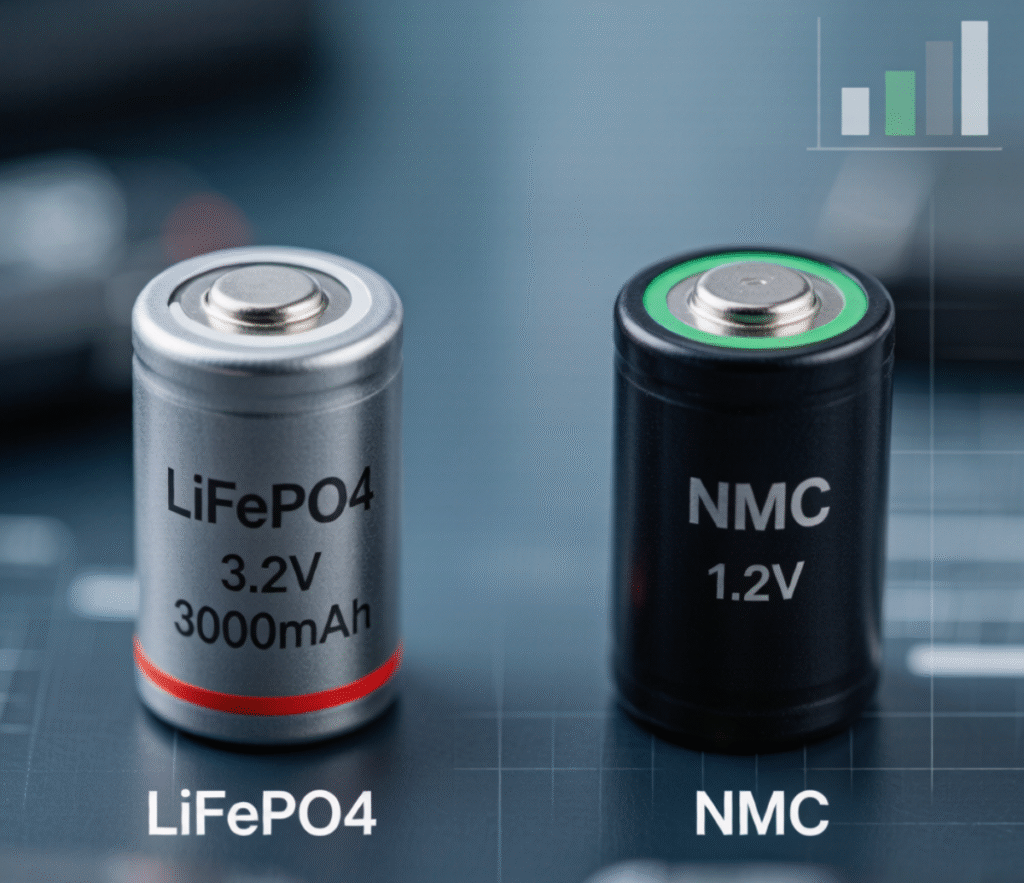
LiFePO4 (Lithium Iron Phosphate) and NMC (Nickel Manganese Cobalt) dominate the lithium battery market. According to the Wikipedia article on LiFePO4, this chemistry offers exceptional safety and longevity. NMC, covered in the lithium-ion battery article, prioritizes energy density. Understanding the trade-offs is essential for selecting the right battery for your application.
LiFePO4 Explained
LiFePO4 is the safest lithium chemistry with the longest cycle life: 2,000-5,000 cycles at 80% depth of discharge. Excellent thermal stability — does not enter thermal runaway below 270°C. Flat discharge voltage curve provides consistent power. Lower energy density than NMC (90-160 Wh/kg). Maintenance-free and environmentally friendly. Ideal for solar energy storage, RVs, golf carts, marine, and UPS applications where safety and longevity matter most. Jetray’s LiFePO4 batteries are available from 12V to 72V configurations.
NMC Explained
NMC (Lithium Nickel Manganese Cobalt Oxide) offers higher energy density (150-260 Wh/kg) than LiFePO4, making it ideal for applications where space and weight are critical. NMC delivers higher voltage (3.6-3.7V nominal vs 3.2V for LiFePO4). However, cycle life is shorter (1,000-2,000 cycles). NMC requires more sophisticated BMS thermal management. It is the preferred choice for power tools, electric vehicles, medical devices, and portable electronics where compact size is essential.
Safety and Thermal Stability
| Property | LiFePO4 | NMC |
|---|---|---|
| Thermal runaway onset | >270°C | 150-180°C |
| Chemical stability | Excellent (olivine structure) | Moderate (layered structure) |
| Gas generation | Minimal under abuse | Can release oxygen at high temp |
| BMS requirement | Standard | Advanced thermal management |
Cycle Life Comparison
LiFePO4: 2,000-5,000 cycles at 80% DoD, 3,000-7,000 cycles at 50% DoD. Service life: 8-15 years. NMC: 1,000-2,000 cycles at 80% DoD, 2,000-3,000 cycles at 50% DoD. Service life: 3-7 years. For applications requiring daily cycling, LiFePO4 is the clear winner. For occasional use where weight matters more, NMC may be suitable.
Energy Density
LiFePO4 specific energy: 90-160 Wh/kg. Energy density: 220-330 Wh/L. NMC specific energy: 150-260 Wh/kg. Energy density: 350-700 Wh/L. For the same physical size, an NMC battery stores 50-100% more energy than LiFePO4. This makes NMC the preferred choice for weight-sensitive applications like portable devices and some EVs.
Cost Analysis
LiFePO4 is typically 10-20% cheaper per kWh than NMC at the cell level. However, NMC’s higher energy density means fewer cells for the same total energy in some applications. Total system cost depends on BMS complexity, cooling requirements, and expected lifespan. Over a 10-year period, LiFePO4 usually delivers lower total cost due to longer cycle life. Jetray provides customized battery solutions optimized for both performance and budget.
Temperature Performance
LiFePO4 operates from -20°C to 60°C with good performance. Capacity retention at -20°C is approximately 60-70%. NMC operates from -20°C to 55°C. Capacity retention at -20°C is approximately 50-60%. Both chemistries benefit from thermal management in extreme temperatures. At high temperatures, LiFePO4 degrades slower than NMC.
Best Applications
LiFePO4: Solar energy storage, home battery backup, golf carts, RVs, marine, UPS, telecom towers, forklifts, off-grid systems. NMC: Electric vehicles (with thermal management), power tools, laptops, medical devices, drones, portable electronics. Jetray offers both chemistries with custom engineering support to match your specific application.
Comparison Table
| Factor | LiFePO4 | NMC |
|---|---|---|
| Energy density | 90-160 Wh/kg | 150-260 Wh/kg |
| Cycle life (80% DoD) | 2,000-5,000 | 1,000-2,000 |
| Safety | Excellent | Good (requires management) |
| Cost per kWh | Lower | 10-20% higher |
| Voltage nominal | 3.2V | 3.6-3.7V |
| Best for | Stationary, deep cycle | Portable, high energy |
FAQ
Which is safer, LiFePO4 or NMC?
LiFePO4 is significantly safer due to its olivine crystal structure that does not release oxygen at high temperatures. Thermal runaway onset is above 270°C compared to 150°C for NMC.
Which battery lasts longer?
LiFePO4 lasts 2-4x longer than NMC in cycle life, typically 2,000-5,000 cycles compared to 1,000-2,000 for NMC.
Which has higher energy density?
NMC has 50-100% higher energy density than LiFePO4, making it better for weight and space-constrained applications.
Which is better for solar energy storage?
LiFePO4 is the preferred choice for solar storage due to longer cycle life, better safety, and lower lifetime cost.
LiFePO4 and NMC Solutions from Jetray
Need help choosing between LiFePO4 and NMC? Jetray Battery engineers have 15+ years of experience across both chemistries. We provide technical data, samples, and custom design support. Explore our custom solutions or contact our team for expert guidance.