













































Battery voltage is the quickest way to estimate state of charge (SOC), but voltage readings vary by chemistry, temperature, and load. This guide provides accurate voltage charts for common battery types. Jetray Battery manufactures precision LiFePO4 battery packs with built-in voltage monitoring.
Voltage Indicates State of Charge
The voltage of a battery drops as it discharges and rises as it charges. By measuring resting voltage (no load for 30+ minutes), you can estimate remaining capacity. However, different chemistries have different voltage curves. The Wikipedia article on state of charge explains the relationship between voltage and SOC.
12V LiFePO4 Voltage Chart
LiFePO4 has a very flat voltage curve — 90% of capacity is delivered between 13.3V and 12.8V resting:
| SOC % | Resting Voltage | Under Load (0.5C) |
|---|---|---|
| 100% | 13.6V+ | 13.2V |
| 90% | 13.3V | 12.9V |
| 80% | 13.2V | 12.8V |
| 70% | 13.1V | 12.7V |
| 60% | 13.0V | 12.6V |
| 50% | 12.9V | 12.5V |
| 40% | 12.8V | 12.4V |
| 30% | 12.7V | 12.3V |
| 20% | 12.5V | 12.1V |
| 10% | 12.2V | 11.8V |
| 0% | 12.0V | 10.0V (BMS cutoff) |
12V Lead-Acid Voltage Chart
| SOC % | Flooded/AGM | Gel |
|---|---|---|
| 100% | 12.7V+ | 12.8V+ |
| 75% | 12.4V | 12.5V |
| 50% | 12.2V | 12.3V |
| 25% | 12.0V | 12.1V |
| 0% | 11.8V | 11.9V |
24V LiFePO4 Voltage Chart
| SOC % | Resting Voltage | Under Load |
|---|---|---|
| 100% | 27.2V+ | 26.4V |
| 80% | 26.4V | 25.6V |
| 60% | 26.0V | 25.2V |
| 50% | 25.8V | 25.0V |
| 30% | 25.4V | 24.6V |
| 20% | 25.0V | 24.2V |
| 0% | 24.0V | 20.0V (BMS cutoff) |
48V LiFePO4 Voltage Chart
For 48V systems (16 cells in series): 100% SOC = 54.4V+ resting, 50% SOC = 51.6V, 20% SOC = 50.0V, BMS cutoff at 48.0V. Multiply 12V values by 4 for approximate 48V readings. Jetray’s LiFePO4 battery packs include accurate SOC monitoring via integrated BMS for all voltage configurations.
Factors Affecting Voltage Readings
Temperature: Cold reduces voltage, warm increases it. Correct for temperature using manufacturer charts. Load: Voltage drops under load due to internal resistance. Always measure resting voltage for accurate SOC. Age: Older batteries have lower voltage at the same SOC. Measurement accuracy: Use a calibrated voltmeter, not the vehicle’s gauge.
Nominal Voltage by Chemistry
| Chemistry | Nominal Cell Voltage | 12V Pack Configuration |
|---|---|---|
| LiFePO4 | 3.2V | 4S (4 cells in series) |
| NMC / NCA | 3.6-3.7V | 3S (3 cells) |
| Lead-acid | 2.0V | 6 cells |
| LTO | 2.3V | 5S or 6S |
BMS and Voltage Protection
Jetray LiFePO4 batteries include a Battery Management System that monitors individual cell voltages and provides over-voltage protection (cutoff at ~3.65V/cell), under-voltage protection (cutoff at ~2.5V/cell), and balancing during charging. The BMS ensures safe operation and extends battery life. Jetray’s custom BMS programming optimizes voltage thresholds for specific applications.
How to Test Voltage Correctly
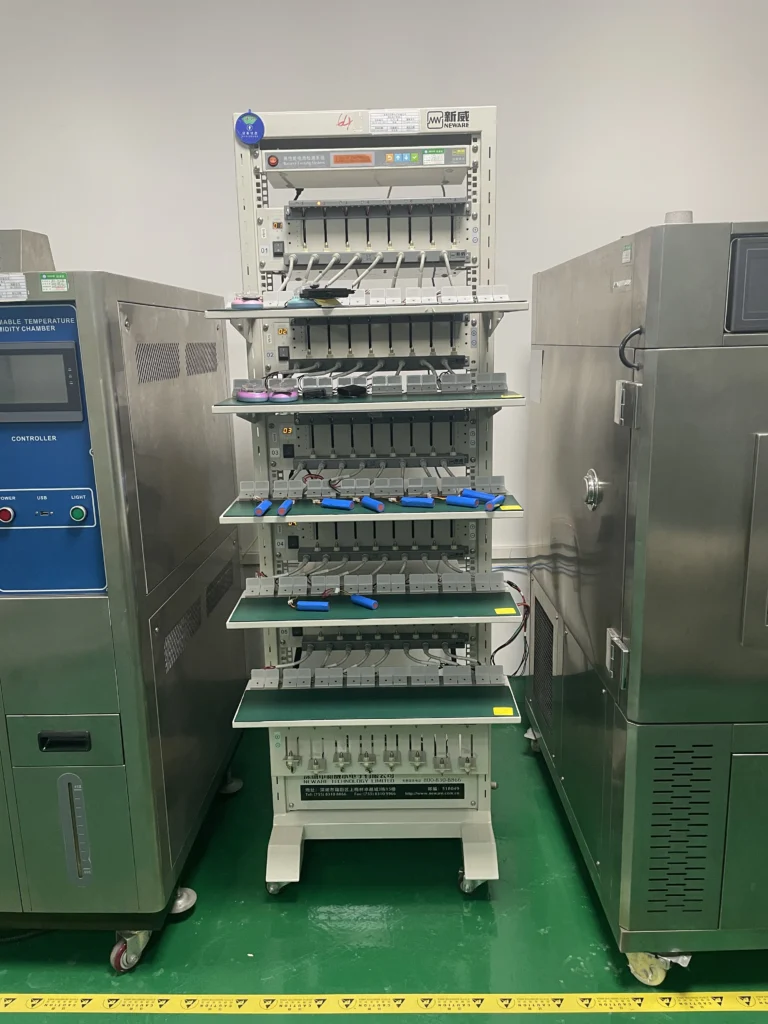
Use a digital multimeter with 0.01V resolution. Let the battery rest for 30+ minutes with no load or charging. Measure at the battery terminals, not at a distribution point. Take multiple readings and average them. Compare to the voltage chart for your specific battery chemistry. For most accurate SOC, track amp-hours in/out with a battery monitor rather than relying solely on voltage. The UL battery testing standards provide voltage measurement protocols.
FAQ
What voltage should a fully charged 12V LiFePO4 battery read?
13.6V or higher at rest. Charging voltage is typically 14.4-14.6V for LiFePO4.
At what voltage is a LiFePO4 battery empty?
BMS typically cuts off at approximately 10.0V for a 12V pack (2.5V per cell). Resting voltage at empty is approximately 12.0V.
Why is LiFePO4 voltage so flat?
LiFePO4 has an extremely flat discharge curve due to its stable olivine crystal structure. This means voltage is not the most accurate SOC indicator.
How do I accurately measure SOC?
Use a coulomb-counting battery monitor for best accuracy. Voltage-based SOC estimation has limitations, especially with LiFePO4’s flat discharge curve.
Precision Battery Monitoring from Jetray
Jetray LiFePO4 batteries include advanced BMS with accurate SOC tracking. Available in 12V, 24V, and 48V configurations with custom voltage protection settings. Browse our battery range or contact our team for technical support.