
1. Why Everyone Talks About the Samsung 18650
Open up any laptop, e-bike, or cordless drill battery pack, and you’ll likely find dozens of identical round cells — each stamped “18650.”
Among all the brands that make this size, Samsung stands out for its balance of power, safety, and availability.
For manufacturers, it’s a trusted component; for consumers, it’s a quiet engine behind countless modern devices.
So what makes these cells so popular — and how do you pick the right one?
Let’s break it down in plain English.
2. What Does “18650” Actually Mean?
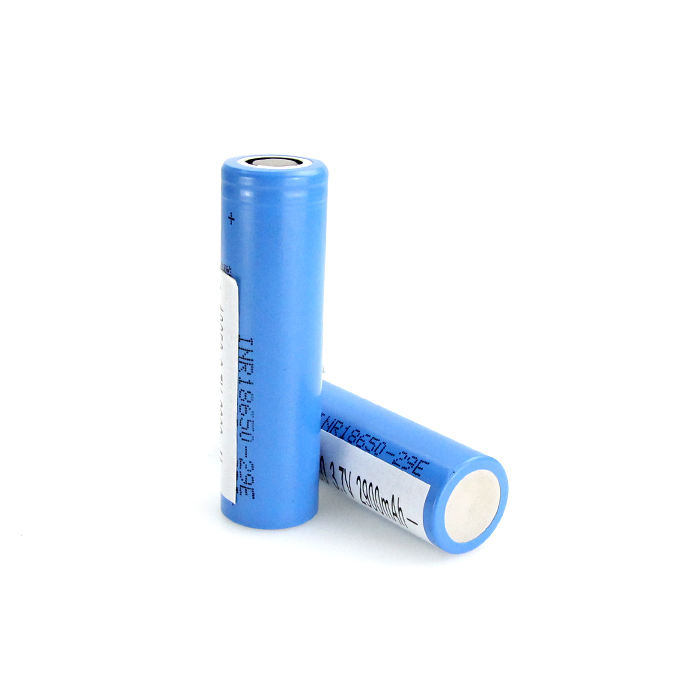
“18650” isn’t a fancy model name — it’s a size standard:
18 mm in diameter
65 mm in length
“0” = cylindrical shape
In short, 18650 refers to the shape and dimensions, not the chemistry.
Samsung’s 18650 batteries are lithium-ion cells, typically using an INR chemistry (Nickel-Manganese-Cobalt oxide, or LiNiMnCoO₂).
This chemistry strikes an ideal balance:
✅ high capacity,
✅ strong discharge capability,
✅ good thermal stability — making it suitable for both high-power and long-life applications.
3. Decoding the Model Names
If you’ve seen labels like INR18650-25R, 30Q, or 35E, here’s what they actually mean:
| Example | Meaning |
|---|---|
| INR | Lithium Nickel Manganese Cobalt oxide chemistry |
| 18650 | Cell dimensions (18×65 mm) |
| 25R / 30Q / 35E | Series & capacity class (2500 mAh / 3000 mAh / 3500 mAh) |
Each model serves a different purpose:
INR18650-25R → ~2500 mAh, 20 A discharge, built for power tools & e-mobility
INR18650-30Q → ~3000 mAh, 15 A discharge, ideal for balanced performance
INR18650-35E → ~3500 mAh, 8 A discharge, perfect for long-runtime systems
👉 Need instant power? Go for 25R.
👉 Need balanced output and capacity? Pick 30Q.
👉 Need maximum runtime? Choose 35E.
4. How the Battery Works Inside
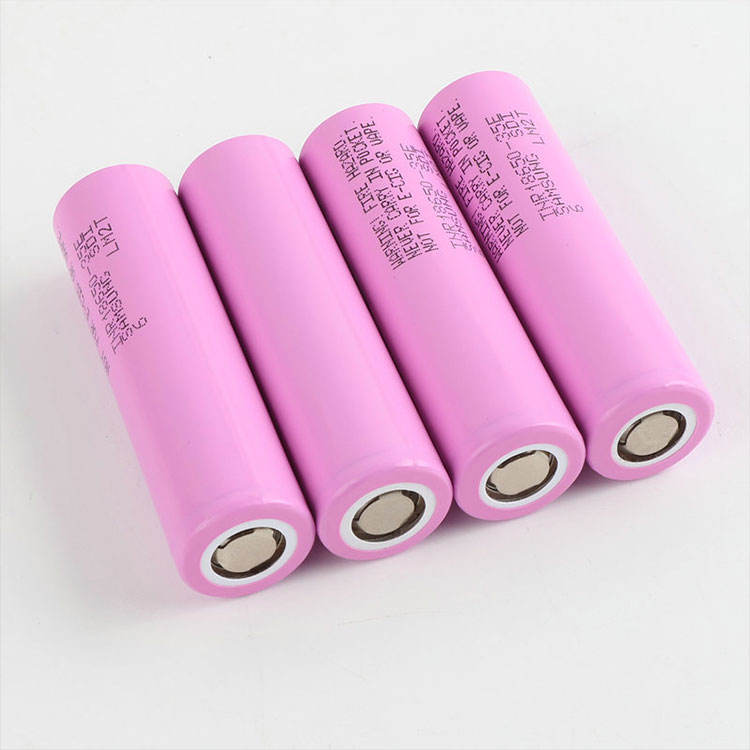
Every 18650 cell contains four essential layers:
Cathode (NMC) – stores lithium ions when charged
Anode (Graphite) – releases ions during discharge
Separator & Electrolyte – allow safe ion flow
Steel casing – provides structure and protection
When charging, lithium ions move from cathode → anode; during use, they flow back, releasing energy.
Samsung’s production process ensures this happens efficiently and safely, even under heavy load or temperature stress — a big reason why their cells earn industrial trust.
5. Core Performance Specs
| Parameter | Typical Range |
|---|---|
| Nominal Voltage | 3.6 – 3.7 V (4.2 V fully charged) |
| Capacity | 2000 – 3500 mAh |
| Max Continuous Discharge | 8 – 20 A (model-dependent) |
| Cycle Life | 500 – 800 cycles |
| Operating Temperature | –20 °C – +60 °C |
| Energy Density | ≈ 250 Wh/kg |
Put simply: one Samsung 35E cell can power a high-efficiency LED lamp for nearly 10 hours straight — from a cylinder smaller than your thumb.
6. Samsung vs. Other Brands
You’ll often hear names like Panasonic, LG, or Sony alongside Samsung.
Here’s how they differ:
Samsung → balanced performance & reliable supply chain
Panasonic → slightly higher energy density (favored for EVs like Tesla)
LG → more cost-effective for consumer electronics
If you’re building OEM packs, energy storage, or industrial tools, Samsung is often the sweet spot between quality, performance, and cost.
7. Where Samsung 18650 Cells Are Used
These cells show up almost everywhere:
🚴 E-bikes & scooters – consistent power delivery
🔧 Power tools – high-current output, stable under load
💻 Laptops & portable electronics – compact battery modules
☀️ Solar storage systems – long cycle life, stable performance
🤖 Robots & industrial equipment – modular and easy to configure
Their standardized size also means easy battery-pack design — you can combine them as:
Series (S) to raise voltage
Parallel (P) to raise capacity
Example: a 4S3P pack = 4 cells in series × 3 in parallel, producing higher voltage and runtime.
8. Safety Rules You Should Never Ignore
Even top-tier Samsung cells can fail if misused. Follow these basics:
Use a CC/CV charger (Constant Current / Constant Voltage)
Don’t charge above 4.2 V per cell
Avoid short-circuits or punctures
Store at 15–25 °C in a dry environment
Never mix new and old cells
Always use a BMS (Battery Management System) for packs to prevent overcharge, over-discharge, or overheating
A little care goes a long way — safety issues almost always come from poor assembly, not the cells themselves.
9. How to Extend Battery Life
You can easily double your cell lifespan by following a few habits:
Avoid deep discharge (don’t drop below 3.0 V)
Don’t store cells fully charged for long periods
Keep temperatures moderate
Periodically check internal resistance and capacity
With good usage, a Samsung 30Q can last 800–1000 full cycles — that’s several years of steady service.
10. Spotting Fakes & Buying Genuine Cells
You can easily double your cell lifespan by following a few habits:
Avoid deep discharge (don’t drop below 3.0 V)
Don’t store cells fully charged for long periods
Keep temperatures moderate
Periodically check internal resistance and capacity
With good usage, a Samsung 30Q can last 800–1000 full cycles — that’s several years of steady service.
11. Recycling and Sustainability
Like all lithium-ion batteries, Samsung 18650 cells should never go into regular trash.
Take them to certified e-waste recyclers
Many regions partner with Samsung for formal recycling programs
For OEM projects, build a return-and-recycle policy to meet ESG and regulatory standards
Proper recycling keeps valuable metals in circulation and reduces environmental impact.
12. Final Thoughts: Picking the Right One
The Samsung 18650 isn’t just a battery — it’s the foundation of countless energy systems.
Its popularity comes from precision manufacturing, balanced design, and consistent quality.
So when choosing, remember:
Need power → pick INR18650-25R
Need balance → go with INR18650-30Q
Need endurance → choose INR18650-35E
The right cell, combined with proper pack design and safety control, will give you a system that’s efficient, reliable, and built to last.