





























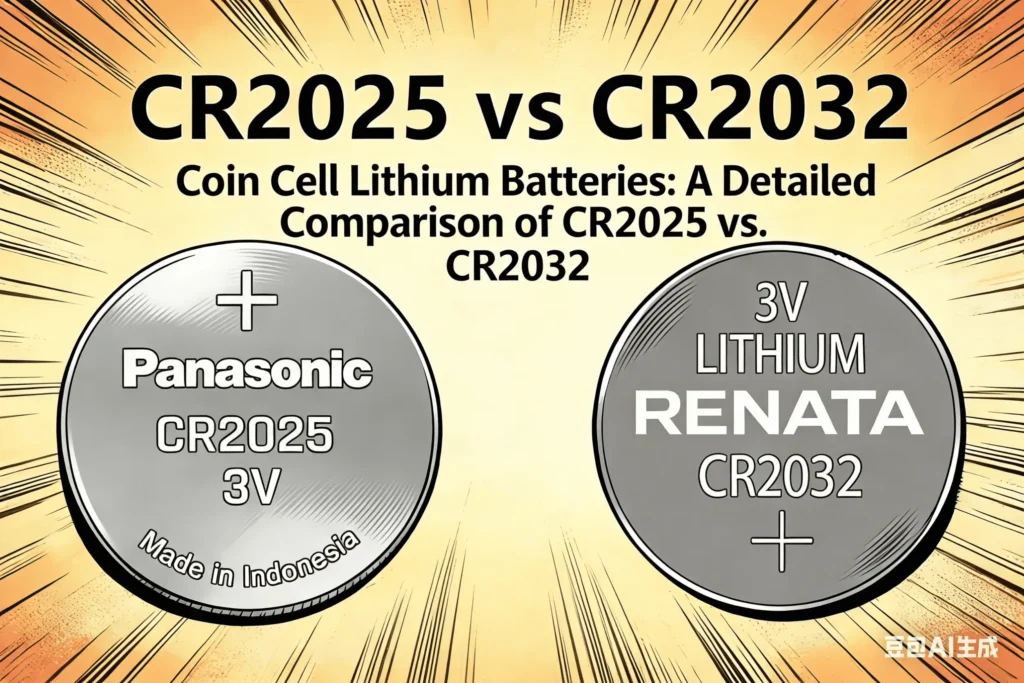
When replacing batteries in car key fobs, remote controls, or small electronic devices, many people encounter two very similar coin cell batteries: CR2025 and CR2032. At first glance, they look almost identical. They share the same diameter, the same voltage, and even the same chemical composition.
However, a small physical difference—just 0.7 mm in thickness—can significantly affect performance, battery life, and device compatibility. Choosing the wrong one may lead to poor contact, unstable power supply, or shortened runtime.
This article provides a clear and practical comparison of CR2025 vs. CR2032, explains whether they are interchangeable, and helps you choose the right battery for your device.
Decoding the Battery Names
Understanding the battery code helps explain why these two cells are similar but not the same.
What Does “CR” Mean?
The prefix CR indicates a lithium manganese dioxide (Li-MnO₂) coin cell battery. This chemistry offers:
A stable 3.0V nominal voltage
Very low self-discharge
Long shelf life, typically 5–10 years
What Do the Numbers Mean?
The numbers describe the battery’s physical size:
20 = diameter of 20 mm
25 / 32 = thickness in tenths of a millimeter
That means:
CR2025 → 20 mm diameter, 2.5 mm thick
CR2032 → 20 mm diameter, 3.2 mm thick
The diameter is identical. The thickness is the key difference.
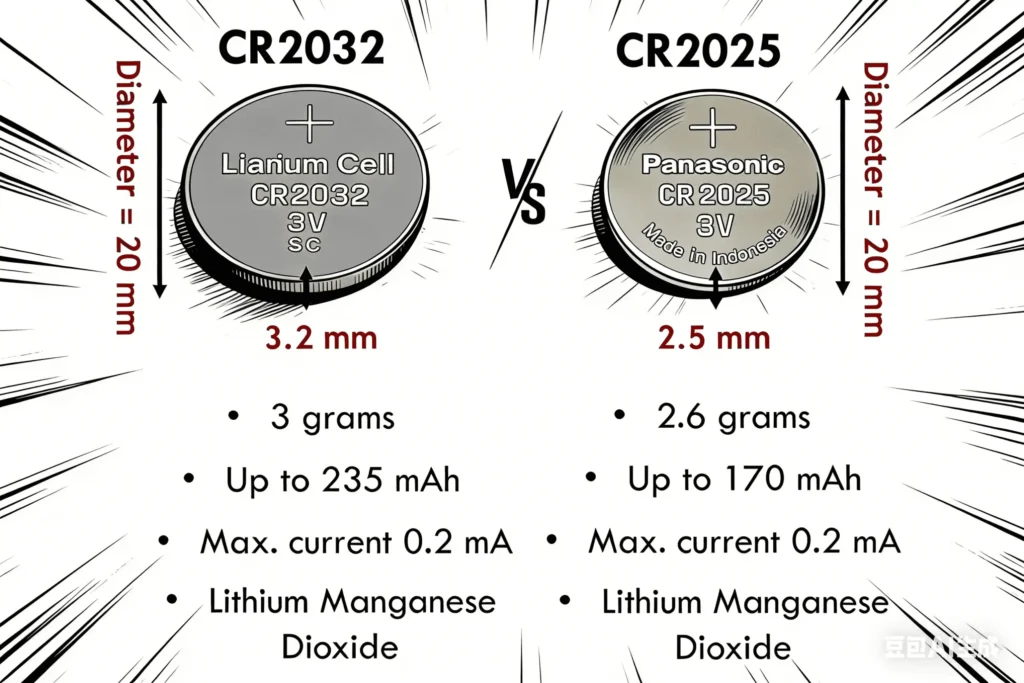
Core Parameter Comparison: CR2025 vs. CR2032
The table below highlights the most important technical differences.
| Parameter | CR2025 | CR2032 |
|---|---|---|
| Chemical system | Lithium manganese dioxide | Lithium manganese dioxide |
| Nominal voltage | 3.0 V | 3.0 V |
| Diameter | 20 mm | 20 mm |
| Thickness | 2.5 mm | 3.2 mm |
| Weight | ~2.5 g | ~3.0 g |
| Typical capacity | 150–170 mAh | 210–240 mAh |
| Battery life | Shorter | Longer (≈40% more capacity) |
| Pulse current ability | Lower | Higher |
| Best for | Ultra-thin devices | Devices needing longer runtime |
| Common applications | Slim remotes, calculators | Car key fobs, CMOS batteries |
| Interchangeability | Emergency only | Generally not recommended |
Capacity and Battery Life
Although both batteries provide the same voltage, CR2032 has a clear advantage in capacity. Its greater thickness allows it to store more active material, resulting in approximately 40% more energy than CR2025.
In real-world use, this means:
CR2032 lasts longer in devices that draw power continuously
CR2025 drains faster under the same load
For devices like car key fobs or medical sensors, the extra capacity of CR2032 often translates into months or even years of additional service life.
Performance and Power Output
CR2032 also performs better under higher or pulsed current loads. This makes it more suitable for devices that transmit signals or wake up frequently.
Typical examples include:
Automotive remote keys
Wireless sensors
Motherboard CMOS batteries
CR2025, by contrast, is better suited to low-drain, intermittent devices, where compact size matters more than runtime.
Are CR2025 and CR2032 Interchangeable?
This is the most common question—and the answer depends on the direction of substitution.
Using CR2025 Instead of CR2032
In some cases, CR2025 can temporarily replace CR2032, but it is not ideal.
Potential issues include:
Loose contact due to reduced thickness
Intermittent power loss
Shorter battery life
A common workaround is placing a small piece of aluminum foil on top of the battery to improve contact. This can work in emergencies but is not recommended for long-term use.
Using CR2032 Instead of CR2025
This is usually not recommended.
Because CR2032 is thicker, forcing it into a device designed for CR2025 may:
Damage the battery holder
Bend contacts
Prevent the battery compartment from closing properly
Only attempt this if the device clearly has extra space and the manufacturer allows it.
Application Guide
Choosing the right battery depends on your device type.
CR2032 Is Best For:
Car key fobs
Computer motherboard CMOS batteries
Medical devices (thermometers, glucose meters)
LED lights with moderate power demand
CR2025 Is Best For:
Ultra-slim remote controls
Calculators
Some fitness trackers
Devices with strict thickness limits
Always check the device manual before replacing the battery.
Buying and Safety Tips
Both CR2025 and CR2032 are non-rechargeable lithium batteries. Attempting to recharge them can cause leakage, overheating, or explosion.
Additional tips:
Store batteries in a cool, dry place
Avoid mixing old and new batteries
Keep coin cells away from children and pets
Coin cell batteries can be extremely dangerous if swallowed.
Conclusion
CR2025 and CR2032 may look nearly identical, but they are designed for different use cases. The voltage is the same, but thickness, capacity, and performance are not.
In summary:
Choose CR2032 for longer battery life and higher power stability
Choose CR2025 when space is limited and power demand is low
Avoid substitutions unless clearly supported by the device
When in doubt, always follow the manufacturer’s recommendation. The correct battery ensures optimal performance, safety, and longevity for your device.