
























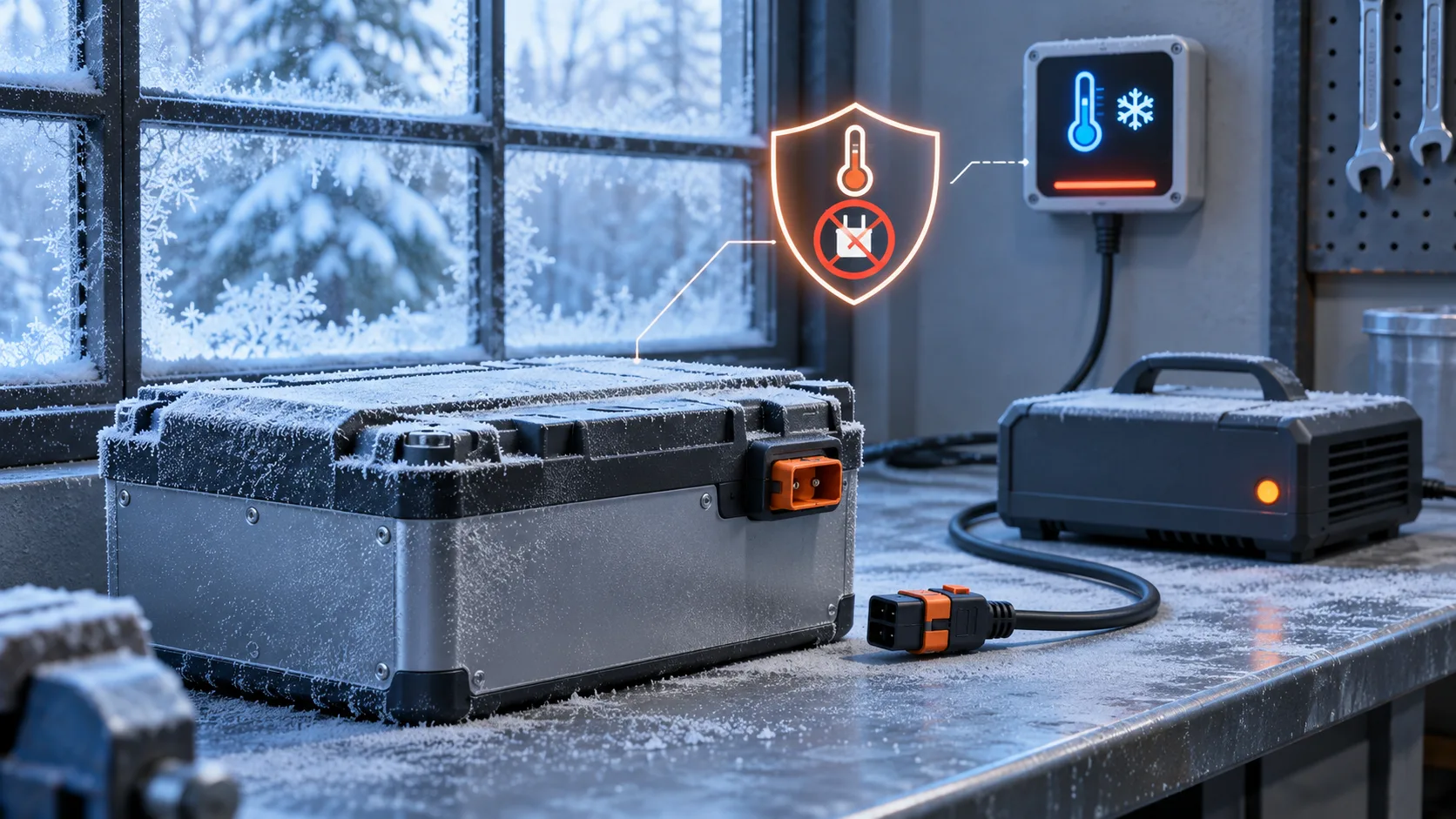
No, you should not charge a lithium battery below 0°C (32°F) unless the pack is specifically designed for it. Charging at sub-freezing temperatures can plate metallic lithium on the anode, which permanently reduces performance and safety. Discharging in the cold is a different matter: most lithium cells can still be used well below freezing.
Key Takeaways
- Battery University lists 0°C to 45°C as the charge window for Li-ion and states that no charge is permitted below freezing.
- A LiFePO4 cell specification from EVE sets charging at 0°C to 55°C, with no charging allowed below 0°C.
- Between 0°C and 10°C the same LiFePO4 cell allows only a reduced charge current of 0.2C, and no fast charging.
- Cold discharging is allowed down to about -20°C for both chemistries, but available capacity drops.
- The fix is to warm the pack above freezing before charging, or buy a pack with a heater and cold-charge protection built in.
Why can’t you charge a lithium battery below freezing?
Cold slows lithium ions inside the anode, so they stop moving in and plate on the surface as metal instead. Battery University’s BU-410 says this plating happens during a sub-freezing charge and leads to permanent degradation in performance and safety. It also notes that a cell with plating is more vulnerable to failure under vibration or other stress.
The damage is easy to miss. The battery may appear to charge normally, but capacity and safety margins are lower from that point on. Three points follow from this:
- Not self-healing: plated lithium does not return to the anode once the cell warms up.
- Hard to see: the pack still reads full voltage, so the user may not notice.
- Cumulative: repeated cold charges add to the loss.
What are the charge and discharge temperature limits?
Most lithium chemistries allow charging from 0°C upward and discharging from about -20°C upward. The table compares the two sources checked for this article.
| Battery type | Charge temperature | Discharge temperature | Source note |
|---|---|---|---|
| Li-ion (general) | 0°C to 45°C | -20°C to 60°C | Battery University BU-410, Table 1 |
| LiFePO4 cell (EVE LF280) | 0°C to 55°C | -20°C to 55°C | EVE product specification, Version E |
| Lead-acid | -20°C to 50°C | -20°C to 50°C | BU-410; charge at 0.3C or less below freezing |
These are cell-level figures. A finished pack adds a BMS and may set tighter limits, so the pack’s own datasheet is the number to follow. Battery University also advises charging between 10°C and 30°C for best results and lowering current when the battery is cold.
How much current is allowed at each temperature?
A LiFePO4 cell from EVE allows full standard charging only above 10°C, and the permitted current falls as it gets colder. The specification gives these limits by cell temperature:
- Below 0°C: charging not allowed.
- 0°C to 10°C: standard charge at 0.2C up to a 3.60V cut-off; fast charge not allowed.
- 10°C to 45°C: standard charge at 0.5C up to 3.65V; fast charge at 1.0C.
- 45°C to 50°C: charge below 0.2C once voltage is under 3.60V.
- 50°C to 55°C: charge below 0.1C once voltage is under 3.60V.
- Above 55°C: charging not allowed.
These values come from the EVE LF280 product specification. Other cells have different tables, so treat this as an example of how a cell maker defines the limit, not as a rule for every pack.
What should you do if the battery is already below 0°C?
Let the battery warm up above freezing before you charge it. The steps below keep the cells safe:
- Move it indoors: bring the pack into a heated room and leave it unplugged.
- Wait for the cells, not the case: a pack can feel warm outside while the cells inside are still cold, so allow extra time.
- Charge slowly at first: if the charger offers a low-current mode, use it until the pack is near room temperature.
- Do not use open heat: avoid flames, heat guns or hot plates on the pack.
Many packs include a BMS that blocks charging when the temperature sensor reads too cold. If your pack refuses to charge in winter, that is the protection working, not a fault.
What are the options for charging in cold climates?
Four approaches let equipment charge in winter without plating the cells:
- Charge indoors: the simplest option for portable and removable packs.
- BMS low-temperature charge cut-off: the BMS stops charging below a set cell temperature and resumes when it warms.
- Heated pack: a heating film warms the cells to the charge window before charging starts.
- Cold-charge cells: Battery University says specialty Li-ion cells can charge to -10°C at a reduced rate, with trade-offs in usable energy and charge time, and that certification for sub-zero charging is costly.
What should OEM buyers check?
Ask the supplier for the pack’s cold-charge behavior in writing, because it decides whether your equipment works in winter. A pack that is fine on a 25°C test bench can stall in an outdoor installation.
- Charge window: the lowest and highest pack temperature at which charging is allowed, per model.
- Derating table: the allowed charge current at each temperature band.
- Sensor position: whether the BMS reads cell temperature or board temperature, and how many sensors it uses.
- Heater option: whether a heater is available, how much power it draws and where that power comes from.
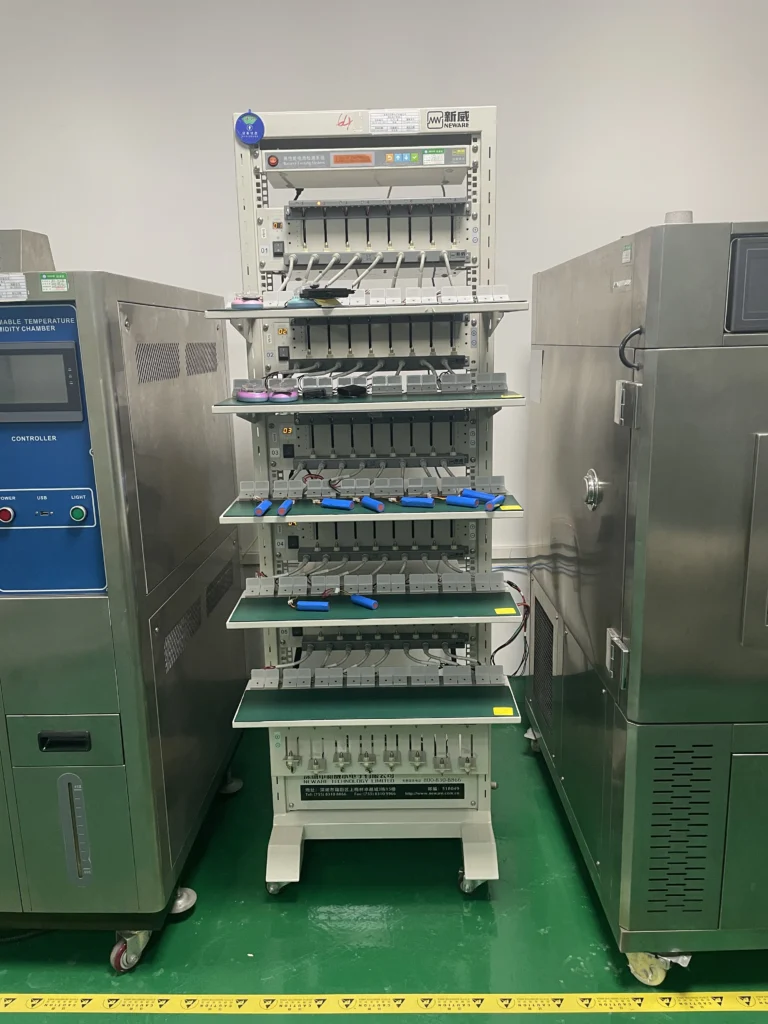
- Cold test evidence: whether the supplier has tested the pack in a temperature chamber and can share the method.
- Certificates: certificate copies, scope and validity for the exact model, since temperature limits are not covered by a general company certificate.
How does Jetray approach this?
Jetray designs custom battery packs including BMS design and enclosure structure, and its Customized Service page lists the working environment as an input. Its contact page asks for operating temperature, humidity and whether the pack is used indoors or outdoors, moving or fixed. That information is what a BMS temperature strategy needs. See LiFePO4 battery packs, lithium-ion battery packs and the BMS functions guide. For the storage side of cold weather, read our guide to storing lithium-ion batteries safely.
Frequently Asked Questions
Can LiFePO4 batteries be charged below 0°C?
LiFePO4 batteries should not be charged below 0°C unless the pack is built for it. A cell specification from EVE does not allow charging below 0°C and limits current to 0.2C between 0°C and 10°C. A pack with a heater or cold-charge protection is the alternative.
Is it safe to discharge a lithium battery in freezing weather?
Yes, discharging a lithium battery in freezing weather is generally allowed, within the discharge range on the datasheet. Battery University lists -20°C to 60°C for Li-ion and the EVE LiFePO4 cell lists -20°C to 55°C. Capacity is lower in the cold, so runtime shortens.
What happens if I charge a lithium battery below freezing by accident?
Charging a lithium battery below freezing can plate metallic lithium on the anode and cause permanent loss of performance and safety. One accidental charge may not cause visible failure, but the damage is cumulative. Stop charging, warm the pack, and check capacity afterwards.
Does a BMS stop charging when the battery is too cold?
Many BMS designs do stop charging below a set temperature, but it depends on the pack. Some BMS units have no temperature protection at all. Ask the supplier whether the BMS has a low-temperature charge cut-off and which temperature it measures.
Need a Lithium Pack for Cold Operating Conditions?
Share your operating temperature range, charging method and current requirement with Jetray and it can propose a pack and BMS configuration to match. Contact us or see the custom battery pack service.
Sources and data checked in November 2026: Battery University BU-410 (Charging at High and Low Temperatures, last updated 1 March 2022); EVE LF280 product specification, Version E, April 2019. Temperature limits shown are cell-level values; a finished pack’s datasheet takes priority.