
VRLA and flooded lead-acid batteries serve different needs within the lead-acid family. Understanding their differences helps you choose the right type for your application. Jetray Battery manufactures LiFePO4 batteries that outperform both types for most modern applications.
Two Lead-Acid Families
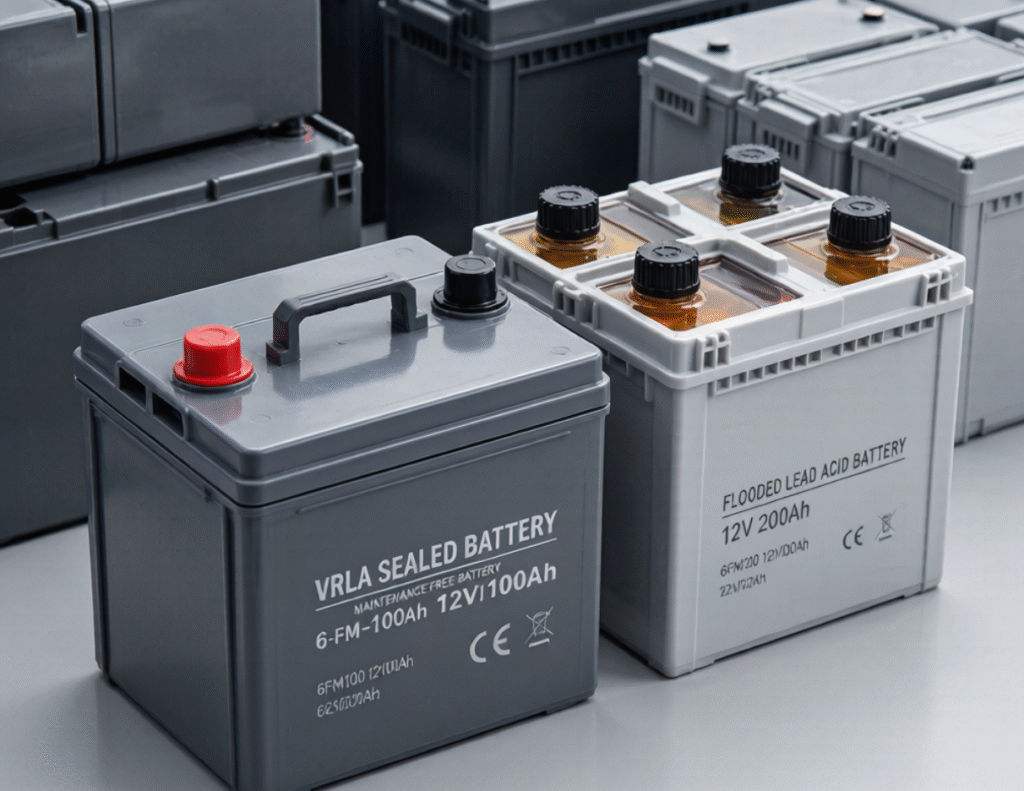
Flooded lead-acid batteries have liquid electrolyte that requires maintenance. VRLA (Valve-Regulated Lead-Acid) batteries are sealed and maintenance-free. The Wikipedia article on VRLA batteries explains the valve-regulated technology. Both types use the same basic lead-acid chemistry but differ in electrolyte management and maintenance requirements.
Flooded Lead-Acid
Flooded lead-acid is the most economical battery type but requires regular maintenance: Electrolyte must be checked monthly and topped up with distilled water. Batteries must remain upright. Hydrogen gas is released during charging, requiring ventilation. Flooded batteries tolerate overcharging better than VRLA. They have the lowest upfront cost per Ah. Cycle life: 300-500 cycles at 50% DoD. Best for applications where maintenance access is available and budget is the primary concern. Uses: solar backup, industrial equipment, forklifts, off-grid systems.
VRLA (Valve-Regulated)
VRLA batteries are sealed with pressure relief valves that release gas only under overpressure conditions. They are maintenance-free, can be mounted in any position, and do not require ventilation (though ventilation is still recommended). VRLA includes two subtypes: AGM and Gel. VRLA batteries cost 20-40% more than flooded but eliminate maintenance labor. They are ideal for remote installations, UPS systems, and applications where maintenance access is difficult.
AGM Subtype
AGM (Absorbent Glass Mat) uses a fiberglass mat to hold electrolyte. Best for: high-current loads, cold temperatures, vibration environments, UPS systems. AGM has the lowest internal resistance among lead-acid types. It can deliver higher currents than gel and charges faster. Cycle life: 400-600 cycles at 50% DoD. AGM is the most popular VRLA type for general use.
Gel Subtype
Gel batteries use silica to immobilize electrolyte. Best for: deep cycling applications, hot environments, frequent discharge cycles. Gel has higher internal resistance than AGM, limiting peak current. Gel is more sensitive to charging voltage — overcharging causes permanent damage. Cycle life: 500-800 cycles at 50% DoD. Gel is preferred for golf carts, floor machines, and solar applications where daily cycling is required. The Wikipedia lead-acid article provides detailed technology information.
Maintenance Comparison
| Task | Flooded | VRLA (AGM/Gel) |
|---|---|---|
| Water top-up | Monthly required | Never |
| Terminal cleaning | As needed | As needed |
| Equalization charge | Monthly required | Not recommended |
| Ventilation | Required | Recommended |
| Orientation | Upright only | Any position |
Total Cost of Ownership
Flooded: $0.50-1.00/Ah initial, $0.30-0.60/cycle per kWh over life. AGM: $1.00-2.00/Ah initial, $0.25-0.50/cycle per kWh. Gel: $1.50-2.50/Ah initial, $0.20-0.40/cycle per kWh. When maintenance labor is factored in, VRLA often has lower total cost despite higher initial price. Jetray’s LiFePO4 alternatives typically deliver $0.05-0.15/cycle per kWh — significantly lower lifetime cost.
Safety and Ventilation
Flooded batteries release hydrogen gas during charging. They require ventilation to prevent hydrogen accumulation. VRLA batteries recombine 99%+ of internal gas, minimizing release. However, under fault conditions, valves may release gas. VRLA can be used in occupied spaces with basic ventilation. The OSHA battery safety guidelines cover ventilation requirements for both types.
Application Guide
Solar power backup: Flooded (budget) or Gel (cycling). UPS systems: VRLA (AGM preferred). RV house power: VRLA (AGM or Gel). Golf cart: Flooded (economy) or Gel (premium). Telecom towers: VRLA (AGM). Floor machines: Gel. Off-grid: Flooded or LiFePO4. For new installations, Jetray recommends evaluating LiFePO4 batteries for their superior performance across all applications.
Comparison Table
| Factor | Flooded | AGM | Gel |
|---|---|---|---|
| Maintenance | Yes (monthly) | None | None |
| Ventilation | Required | Minimal | Minimal |
| Cycle life (50% DoD) | 300-500 | 400-600 | 500-800 |
| Cost per Ah | $0.50-1.00 | $1.00-2.00 | $1.50-2.50 |
| Best for | Budget, maintenance access | General, high-current | Deep cycling, hot environments |
FAQ
What is the difference between VRLA and flooded?
VRLA is sealed and maintenance-free. Flooded requires water top-up and ventilation. VRLA costs more upfront but requires less maintenance.
Which lasts longer, VRLA or flooded?
Gel VRLA typically lasts the longest (500-800 cycles). Flooded and AGM are similar (300-600 cycles). Proper charging significantly affects all types.
Can I replace flooded with VRLA?
Yes, in most applications. Ensure the charger is compatible. VRLA may require a different charging voltage profile than flooded batteries.
Is VRLA worth the extra cost?
For installations where maintenance access is difficult or labor costs are high, VRLA’s maintenance-free operation justifies the premium. For budget-sensitive applications with maintenance access, flooded remains viable.
Modern Battery Solutions from Jetray
Considering VRLA or flooded? Jetray also offers LiFePO4 batteries that outperform both with zero maintenance, 10x longer life, and lighter weight. Explore LiFePO4 options or contact our team for application-specific recommendations.