
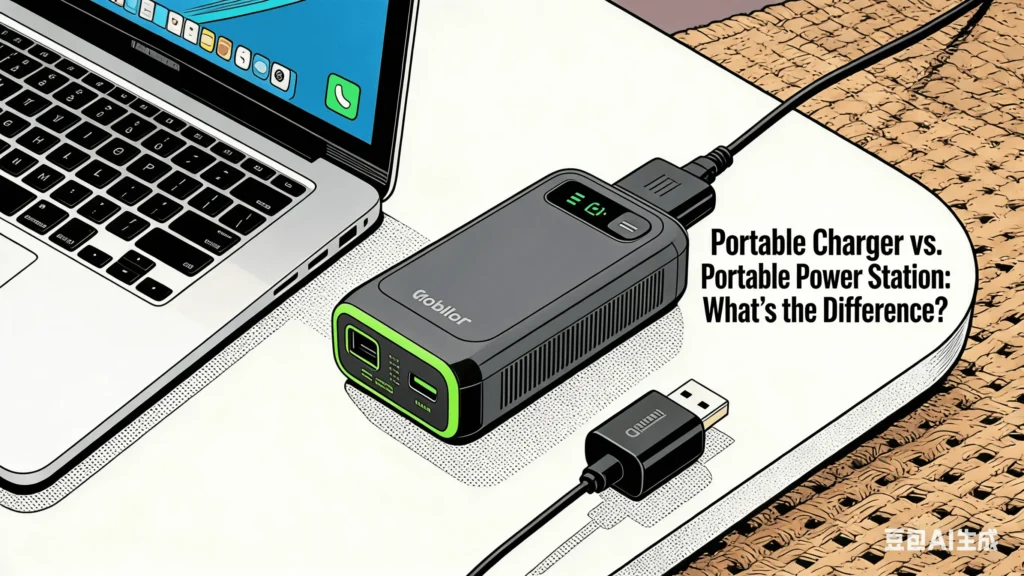
As more of our daily life depends on electronic devices, portable power has become essential. From smartphones and laptops to camping gear and emergency backup, people often face the same question:
Should I buy a portable charger or a portable power station?
At first glance, they seem similar. Both store electricity and provide power when you are away from the grid. But in reality, they are designed for very different needs. This guide explains the key differences in simple terms and helps you choose the right option based on how you actually use power.
1. What Is a Portable Charger?
A portable charger, often called a power bank, is a small battery device designed mainly for charging personal electronics.
It has a built-in battery and usually outputs power through USB-A or USB-C ports. Some newer models also support fast charging or wireless charging.
Portable chargers are made for convenience. You charge them from a wall outlet, then carry them with you to recharge devices like phones or earbuds when needed.
Typical characteristics
Capacity measured in mAh (milliamp-hours)
USB output only
Pocket-size or bag-friendly
Designed for short-term, low-power use
In everyday language, “portable charger” and “power bank” usually mean the same thing.
2. What Is a Portable Power Station?
A portable power station (PPS) is a much larger and more powerful energy system.
Instead of focusing only on USB charging, it provides multiple output types, including AC wall sockets, DC outputs, and USB ports. In simple terms, it works like a small, portable power outlet.
Portable power stations are commonly used for camping, RVs, outdoor work, and home backup during power outages.
Typical characteristics
Capacity measured in Wh or kWh
AC, DC, and USB outputs
Larger and heavier
Can power appliances, not just electronics
A PPS is closer to a battery generator than a phone charger.
3. Key Differences at a Glance
| Feature | Portable Charger (Power Bank) | Portable Power Station |
|---|---|---|
| Capacity | Small (10–20 Wh typical) | Large (200 Wh to 25 kWh) |
| Output | USB only | USB + AC + DC |
| Power Level | Low | Medium to high |
| Size & Weight | Pocket-size | Box-shaped, heavy |
| Recharge Methods | Wall outlet | Wall, car, solar |
| Best For | Phones, tablets | Appliances, tools, backup |
4. Capacity: mAh vs. Wh (Why It Matters)
One common source of confusion is capacity labeling.
Portable chargers use mAh, which works well for small batteries. For example, a 10,000 mAh power bank can charge a smartphone two or three times.
Portable power stations use Wh (watt-hours) or kWh, which better reflect real energy storage. A 1,000 Wh power station can run a refrigerator, CPAP machine, or power tools for hours.
Rule of thumb:
mAh = personal electronics
Wh = real power usage
5. Output Power and What You Can Run
Portable chargers
These are designed for low-power devices:
Smartphones
Tablets
Wireless earbuds
Smartwatches
They cannot power devices that require AC electricity, such as TVs or coffee makers.
Portable power stations
These can handle much higher loads:
Laptops and monitors
Small refrigerators
Electric fans
Medical devices (CPAP)
TVs and routers
Some tools and kitchen appliances
If the device has a standard wall plug, you need a portable power station, not a power bank.
6. Portability: Size and Weight
Portability means different things in different contexts.
A portable charger fits in your pocket and weighs a few hundred grams. You can carry it all day without noticing it.
A portable power station may weigh anywhere from 5 kg to over 30 kg. Some larger models include handles or wheels. They are portable in the sense that you can move them, but not something you carry casually.
7. Recharging Options
Portable chargers usually recharge only from a wall outlet or USB charger.
Portable power stations offer much more flexibility:
Wall charging
Car charging
Solar panel input
Generator input (in some cases)
This makes them suitable for outdoor and off-grid use, where wall power is not available.
8. Use Case Scenarios: Which One Should You Choose?
Daily commuting and travel
Choose a portable charger.
If you just need extra phone battery during the day or while traveling, a power bank is lightweight, cheap, and effective.
Camping and outdoor trips
Choose a portable power station.
If you want to run lights, a cooler, a coffee machine, or charge multiple devices at once, a power bank is not enough.
Home power outages
Choose a portable power station.
A power bank can keep your phone alive. A power station can keep your fridge, router, and medical devices running.
Business or industrial use
Portable power stations are better suited for field work, emergency equipment, and mobile operations where stable AC power is required.
9. Cost Considerations
Portable chargers are inexpensive and widely available. Prices are usually low, and replacement is easy.
Portable power stations cost more, sometimes significantly more. However, they also replace multiple devices at once and can serve as emergency power systems or off-grid solutions.
The key is to match the cost to actual need, not maximum capacity.
10. Final Thoughts
Although their names sound similar, portable chargers and portable power stations serve very different purposes.
A portable charger is a simple, everyday accessory for phones and small electronics.
A portable power station is a serious energy solution designed to replace wall power when you need it most.
Before buying, ask yourself one simple question:
Do I need extra battery life, or do I need real power?
The answer will make the choice clear.