
Match the battery voltage to the trolling motor first. Minn Kota’s battery and wiring guide puts motors up to 55 lb of thrust on 12V, 70–80 lb on 24V and 101–112 lb on 36V. Then divide usable amp-hours by the average current the motor draws to estimate runtime. Finally, confirm that the lithium battery’s continuous discharge rating is higher than the motor’s maximum draw.
Key Takeaways
- Thrust sets voltage: in Minn Kota’s 2021 sizing table, 30–55 lb motors are 12V, 70–80 lb motors are 24V and 101–112 lb motors are 36V.
- Runtime in hours is usable amp-hours divided by average amps. A 12V motor rated for 50A maximum drains a 100Ah battery in about 2 hours at full power, and lasts longer at normal speeds.
- Maximum amp draw is an intermittent peak, so size the battery’s continuous discharge rating, the BMS and the breaker for that peak.
- Minn Kota’s guide is written for lead-acid batteries and does not cover lithium, so confirm lithium use, series wiring and charging with the battery and motor makers.
Which voltage does your trolling motor need?
Your trolling motor’s rated voltage decides the battery voltage, and thrust usually decides the motor voltage. Minn Kota’s battery and wiring guide lists 12V for 30–55 lb motors, 24V for 70–80 lb motors, 36V for 101–112 lb motors and 48V for its E-Drive.
- 12V: one 12V battery runs the motors up to 55 lb of thrust.
- 24V: two 12V batteries in series, or one 24V lithium pack, run the 70–80 lb motors.
- 36V: three 12V batteries in series, or one 36V pack, run the 101–112 lb motors.
| Motor thrust | System voltage | Max amp draw | Approx. watts at full power | Minn Kota breaker size | 12V lead-acid batteries in the manual’s setup |
|---|---|---|---|---|---|
| 30 lb | 12V | 30A | 360W | 50A | 1 |
| 40–45 lb | 12V | 42A | 504W | 50A | 1 |
| 50–55 lb | 12V | 50A | 600W | 60A | 1 |
| 70 lb | 24V | 42A | 1,008W | 50A | 2 |
| 80 lb | 24V | 56A | 1,344W | 60A | 2 |
| 101 lb | 36V | 46A | 1,656W | 50A | 3 |
| 112 lb | 36V | 52A | 1,872W | 60A | 3 |
Amp draw, breaker size and battery count come from the Minn Kota Battery & Wiring Installation guide (Rev. 8.17.2021). The watts column is our own estimate: system voltage times maximum amps. Current motor models can differ, so use the numbers on your motor’s own label and manual.
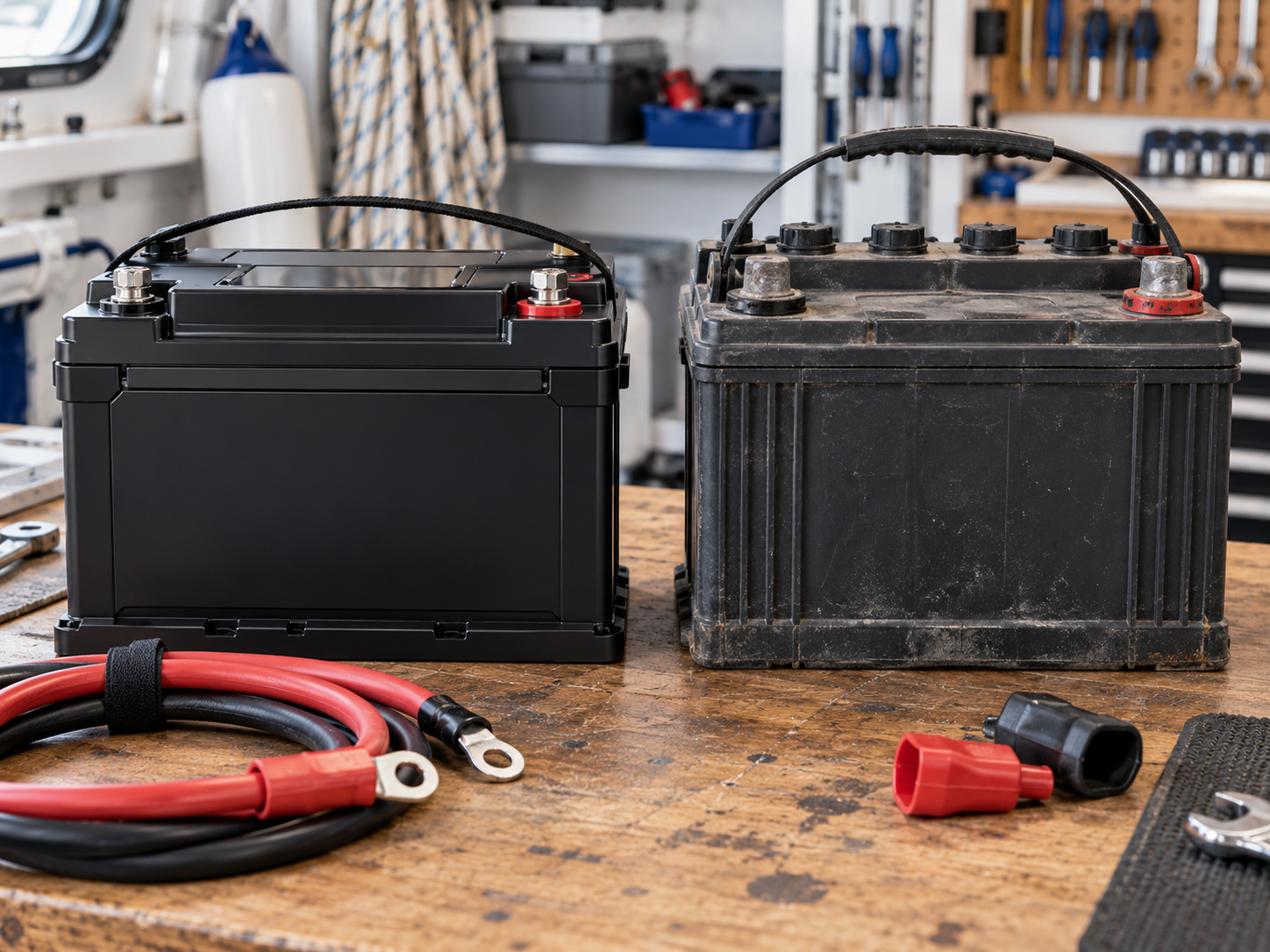
A lithium battery’s label voltage is nominal. Battery University lists the nominal LiFePO4 cell voltage as 3.20V or 3.30V, so a four-cell “12V” pack is usually labeled about 12.8V. Check the pack’s operating voltage range against what the motor accepts. Jetray’s lithium battery voltage guide explains how to read these ratings.
How many amp-hours do you need?
Runtime in hours equals usable amp-hours divided by the average current the motor draws. A trolling motor rarely runs at full power all day, so use two numbers: the maximum draw from the table above for the worst case, and your own average speed for the real trip.
- Find the maximum draw: 50A for a 12V 55 lb motor, 56A for an 80 lb 24V motor.
- Estimate average draw: pick the share of maximum power you expect to use over a day.
- Multiply by hours: average amps × hours on the water gives the amp-hours the trip needs.
- Add a reserve: this guide uses 20% as an example margin, not a standard.
Worked example: a 12V 55 lb motor averaging 20A (an assumed figure, not a measurement) for 6 hours needs 120Ah. With a 20% reserve that is 144Ah, so a single 100Ah battery covers about 5 hours and two in parallel cover the day.
| Motor (max draw) | 50Ah battery | 100Ah battery | 200Ah battery |
|---|---|---|---|
| 12V, 50–55 lb (50A) | 1.0 h | 2.0 h | 4.0 h |
| 24V, 80 lb (56A) | 0.9 h | 1.8 h | 3.6 h |
| 36V, 112 lb (52A) | 1.0 h | 1.9 h | 3.8 h |
The table shows hours at continuous full power, calculated as amp-hours divided by maximum amps. Real runtime is longer because Minn Kota notes that maximum amp draw only occurs intermittently. Cold water, wind, current and boat load push the average up.
Typical use cases change the target:
- Short trips on a kayak or small skiff: a 12V motor of 30–45 lb and a smaller battery can be enough.
- Full-day fishing on a 12V motor: size from your average draw and add the reserve.
- Heavy boats, wind or current: move to a 24V or 36V motor and size amp-hours from that motor’s maximum draw.
Does the battery’s discharge rating cover the motor?
Yes, it must: the battery’s continuous discharge current should be higher than the motor’s maximum amp draw. Minn Kota states that its maximum amp draw values occur intermittently and should not be used as continuous load ratings, so treat them as peaks that the battery, the BMS and the wiring must all carry.
- Continuous discharge: compare the battery’s rated continuous amps with the table, for example 50A for a 55 lb motor.
- BMS cut-off: ask what overcurrent limit and delay the BMS uses, because a trip at full throttle stops the motor.
- Breaker and wire gauge: Minn Kota lists a 60A breaker for 50–55 lb motors, and 8, 6, 4, 4 and 2 AWG at 5, 10, 15, 20 and 25 ft of wire extension.
- Installer: the same guide recommends following ABYC standards and using a qualified marine technician for rigging.
The wire sizes assume no more than 5% voltage drop and 105°C-rated insulation. Longer runs, extra loads on the same circuit or a different breaker change the answer, so follow the table’s notes.
Why switch from lead-acid to lithium?
Choose lithium when you want a battery sized to the load rather than to a lead-acid group size. Minn Kota’s guide is written around 12V lead-acid deep-cycle batteries: it recommends at least 110Ah, and lists group 24, 27 and 31 batteries of 70–125Ah. It does not discuss lithium.
| Item | 12V lead-acid deep-cycle (Minn Kota guide) | LiFePO4 pack (what to confirm) |
|---|---|---|
| Sizing basis | At least 110Ah; group 24, 27 or 31 (70–125Ah) | Rated Ah, watt-hours and continuous discharge from the datasheet |
| 36V system | Three 12V batteries in series | One 36V pack is possible if the motor and pack voltage ranges match |
| Recharging | Recharge within 12–24 hours; the guide calls failure to do so the leading cause of premature lead-acid failure | LiFePO4-compatible charger and the maker’s charge profile |
| Cycle life | Depends on type and care; see the maker’s datasheet | Battery University lists LFP at 2,000 cycles and higher; confirm the test conditions on the datasheet |
| Cold charging | Check the maker’s datasheet | Jetray’s 12V 100Ah listing shows a 0–45°C charge window; see the charging section below |
Should you use one battery, series or parallel?
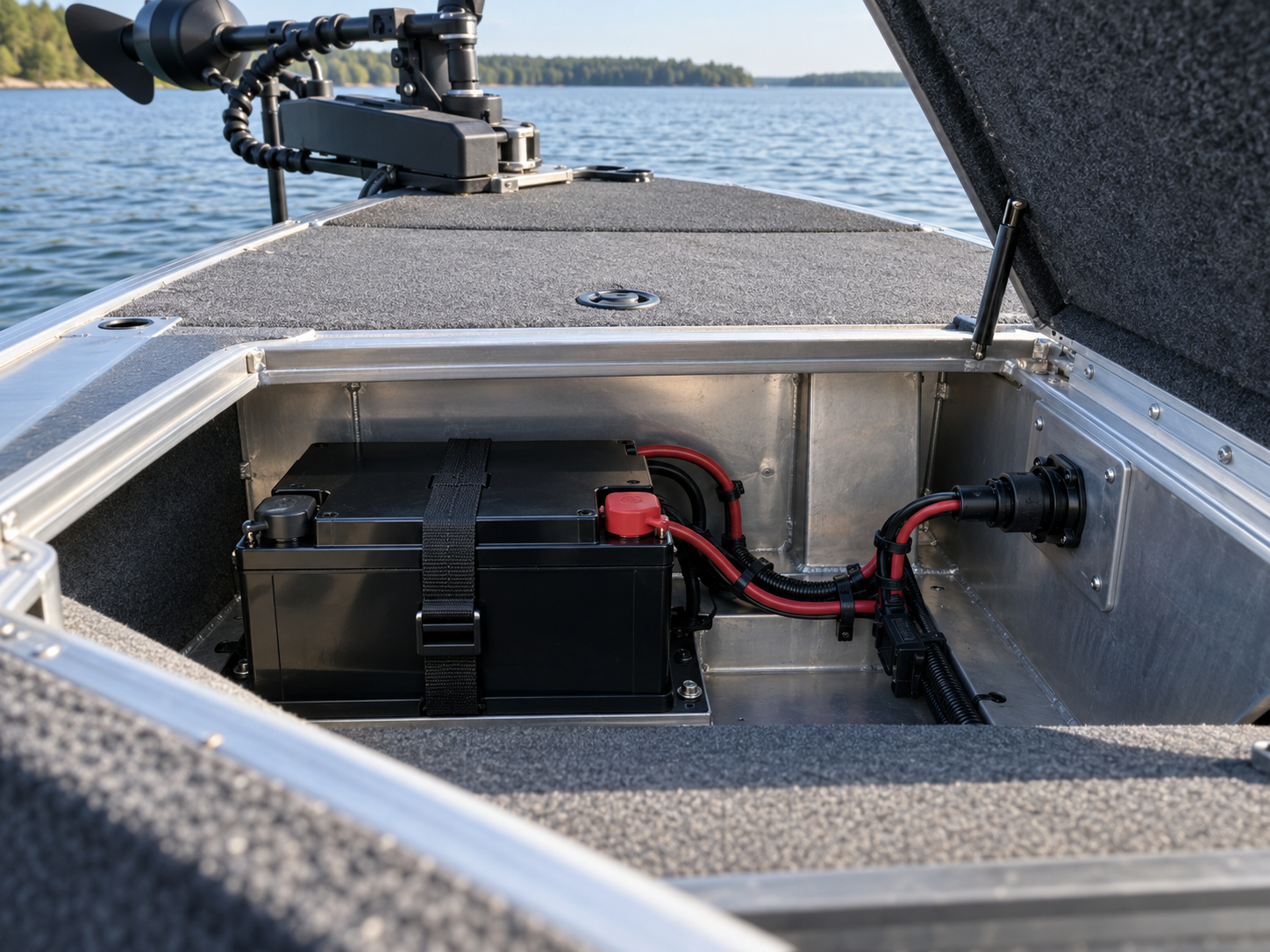
Use one battery of the motor’s voltage whenever one pack of the right voltage and capacity exists. That removes jumper cables and the risk of mismatched batteries. When you need more runtime or higher voltage, series raises voltage and parallel raises amp-hours.
- Series for voltage: two 12V batteries make 24V and three make 36V.
- Parallel for runtime: two 12V batteries in parallel stay at 12V with more amp-hours.
- Matching: Minn Kota says batteries in a multi-battery system must be the same manufacturer, type, size and age.
- Wiring risk: the manual warns that improper wiring of 24, 36 and 48V systems could cause a battery explosion.
For lithium, ask the battery maker how many packs of that model may be connected in series or parallel, because BMS designs differ. Our series and parallel connection guide covers the wiring rules in detail.
How should you charge and install a lithium trolling motor battery?
Charge with a charger made for LiFePO4 and follow the battery maker’s limits. The lead-acid advice in Minn Kota’s guide, such as recharging within 12–24 hours, is specific to lead-acid batteries.
- Charge temperature: Jetray’s 12V 100Ah LiFePO4 listing shows charging at 0–45°C and discharging at −20–60°C.
- Freezing mornings: Battery University says charging Li-ion below freezing can plate metallic lithium and cause permanent damage, so warm the battery first.
- Terminals: the US Coast Guard’s installed-battery rule, 33 CFR 183.420, says a battery must be installed so metal objects cannot touch its ungrounded terminals. Check whether the rule applies to your boat, because the practice is sound either way.
- Isolation: Minn Kota advises disconnecting the motor from the battery while charging and not switching the motor on until the propeller is in the water.
What should OEM buyers check?
Buyers who build boats, trolling motor kits or battery packs under their own brand should ask the supplier for a short specification and document list. Ask for these items before you approve a sample.
- Voltage range: nominal and operating voltage, compared with the motor’s accepted range. Jetray’s 12V 100Ah listing, for example, shows a 10–14.6V operating range.
- Current: continuous and peak discharge current and how long the peak is allowed, compared with the motor’s maximum draw.
- BMS behavior: protection limits, cut-off delay, and how the pack resets after an overcurrent trip.
- Series and parallel limits: the maximum number of packs allowed and the matching rules.
- Fit and terminals: dimensions, weight, terminal type, and where the battery sits in the boat.
- Transport documents: 49 CFR 173.185 requires the manufacturer and later distributors to provide a UN 38.3 test summary for lithium batteries made from 2008 on. Ask for the summary for the exact model.
- Certificates: ask for copies of any certificates, with their scope and validity dates, and confirm your model is covered.
How does Jetray approach this?
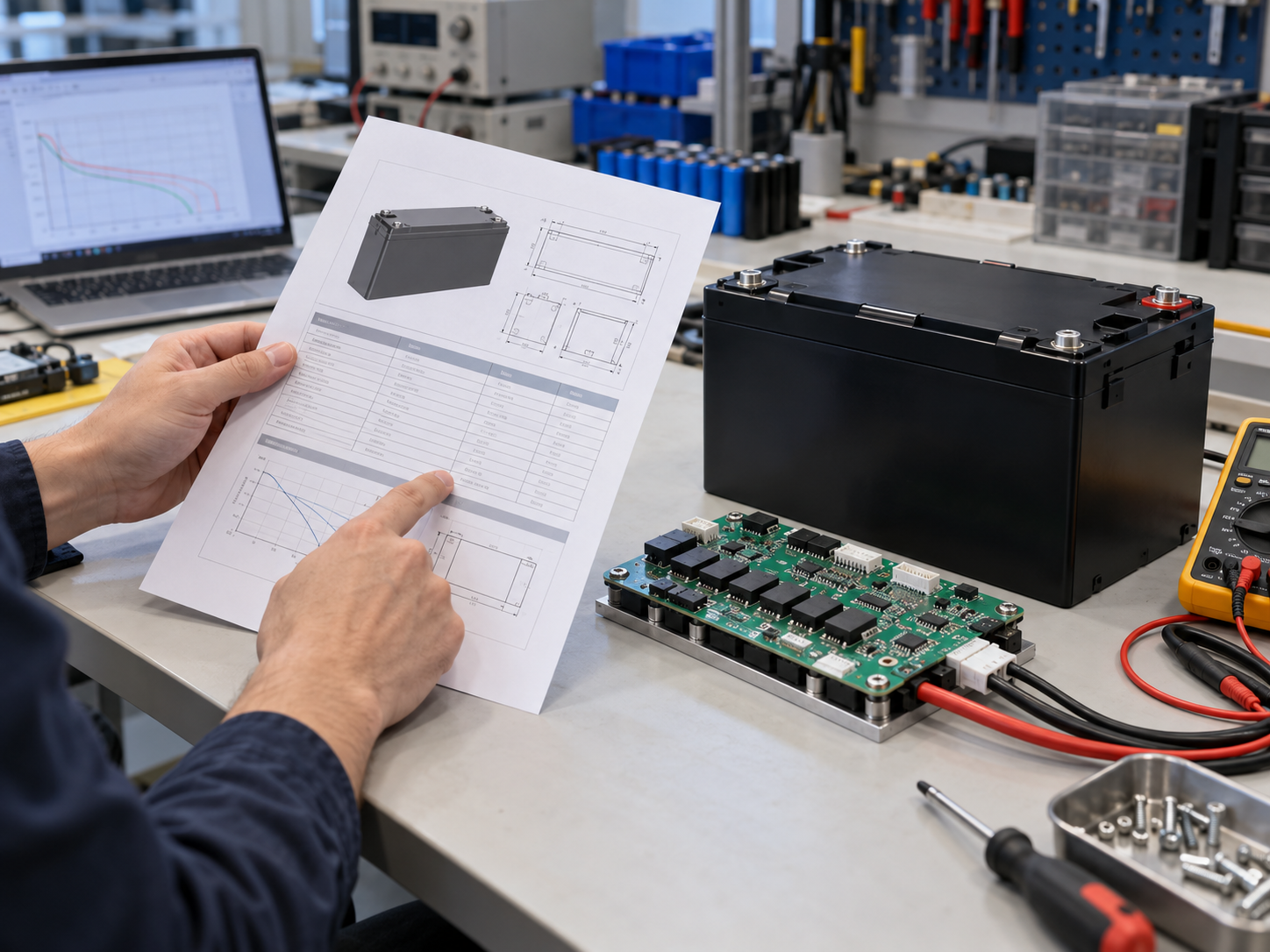
Jetray is a lithium battery pack manufacturer in Shenzhen, China, and it lists LiFePO4 packs from 12V to 72V. Its listings state their ratings plainly, and none of the packs mentioned here is marketed for trolling motors, so confirm fit with Jetray first.
- 12V: the 12V 100Ah LiFePO4 battery is listed at 12.8V nominal, with a 1.0C maximum discharge (100A on a 100Ah pack), a 307×169×208 mm body, and “Other” as its application area. Browse the full 12V LiFePO4 range.
- 24V: the 24V 100Ah LiFePO4 battery is listed at 25.6V nominal and 2,560 Wh, with a 20–29.2V operating range and a 1.0C maximum discharge.
- Custom packs: Jetray says its custom service covers cell selection, BMS design, enclosure and communication, including CAN, RS485, Bluetooth and WiFi options.
Pricing, minimum order quantity and lead time are confirmed per project, so ask for them with your specification.
Frequently Asked Questions
What size lithium battery do I need for a trolling motor?
The size of the lithium battery for a trolling motor equals average amps times hours on the water, plus a reserve. For a 12V motor rated at 50A maximum, a 100Ah battery runs about 2 hours at full power and longer at normal speeds.
Can I use a 24V lithium battery on a 12V trolling motor?
No, a lithium battery for a trolling motor must match the motor’s rated voltage. Minn Kota’s sizing table shows 12V motors up to 55 lb of thrust, 24V motors at 70–80 lb and 36V motors at 101–112 lb.
Do I need a special charger for a lithium trolling motor battery?
Yes, a lithium trolling motor battery needs a charger made for its chemistry, such as LiFePO4, and the maker’s charge settings. Do not use lead-acid advice, such as the 12–24 hour recharge rule in Minn Kota’s guide, as a lithium charging plan.
Can I wire two 12V lithium batteries in series for a 24V trolling motor?
Two 12V lithium batteries can make 24V for a trolling motor only if the battery maker approves series connection of that model. Minn Kota’s guide requires matching manufacturer, type, size and age, and warns that improper wiring of 24V and higher systems could cause a battery explosion.
How long will a 100Ah lithium battery run a trolling motor?
A 100Ah lithium battery runs a 12V trolling motor with a 50A maximum draw for about 2 hours at full power. At an average of 20A, an assumed figure, the same battery lasts about 5 hours before any reserve.
Need a Custom LiFePO4 Pack for Marine Use?
Send Jetray your voltage, continuous and peak current, capacity, size limits and operating conditions through the contact page, or read about its custom battery pack service.
Sources and data checked in October 2026: Minn Kota Battery & Wiring Installation guide (Rev. 8.17.2021), Battery University BU-205 and BU-410, 33 CFR 183.420, 49 CFR 173.185, and Jetray product listings.