
Every drone and RC hobbyist has done it — finished a flying session, landed with a partially charged battery, and left it sitting for weeks. The next time you reach for that battery, it is puffy, won’t charge, or has significantly reduced capacity.
This is the consequence of improper LiPo storage. This guide explains why storage voltage matters, what the right voltage is, and how to keep your LiPo batteries healthy during downtime.
For quality LiPo batteries, visit Jetray LiPo Batteries.
Why Storage Voltage Matters
Fundamental fact: LiPo batteries are chemically active at all states of charge. The internal chemical reactions that produce power during use continue — slowly — during storage. The rate of these reactions depends heavily on voltage and temperature.
At full charge (4.2V/cell), the electrolyte is under high oxidative stress. Over weeks and months, this stress breaks down the electrolyte, generates gas (swelling), and permanently reduces capacity. At very low charge (<3.0V/cell), the copper current collector can dissolve and re-deposit as dendrites, causing internal short circuits.
The Battery University research shows that storage at 40-50% state of charge (3.8V/cell) reduces capacity loss to under 5% per year, compared to 20%+ per year at full charge.
The Ideal Storage Voltage
| State | Voltage/Cell | Capacity Loss/Month | Risk Level |
|---|---|---|---|
| Fully charged | 4.20V | 1-2% | High swelling risk |
| Storage recommended | 3.80-3.85V | <0.3% | Safe |
| Partially charged | 3.50-3.70V | 0.3-0.5% | Moderate |
| Low voltage | 3.00-3.30V | 0.5-1% | Risk of over-discharge |
| Over-discharged | <3.00V | Permanent damage | Do not charge! |
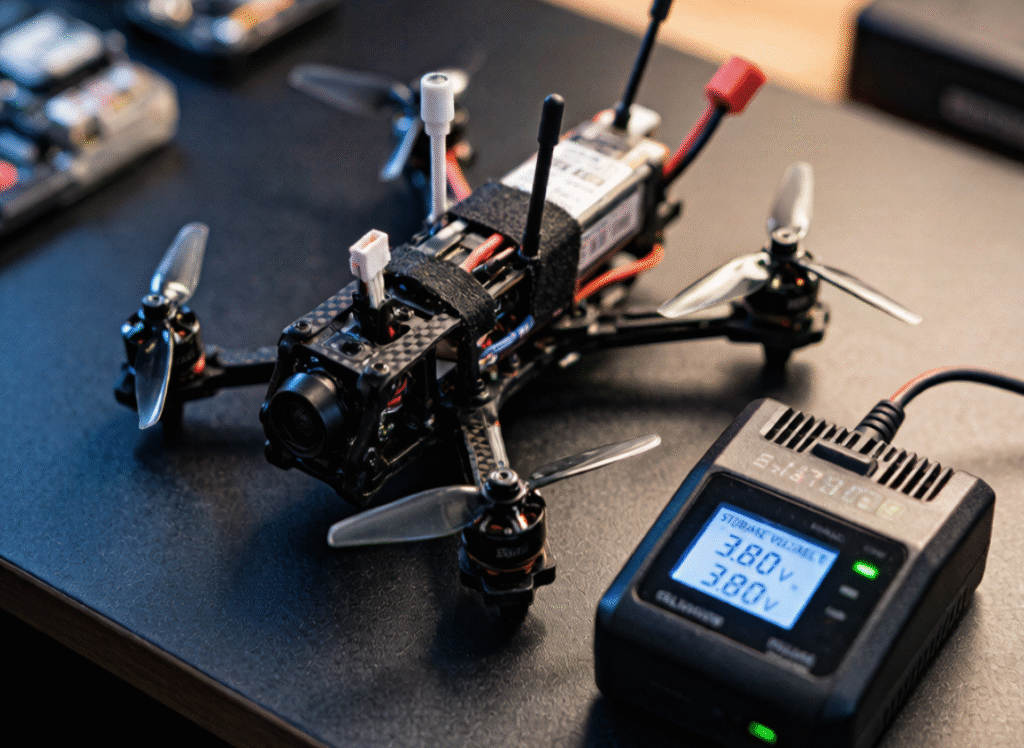
The 3.8V rule: Store every LiPo battery at 3.8V per cell. Most modern hobbyist chargers have a ‘Storage’ function that automatically charges or discharges to this voltage. Use it every time you put a battery away for more than 24 hours.
Risks of Wrong Storage
Storing fully charged: Swelling (puffy battery), 10-20% permanent capacity loss over 6 months, increased internal resistance (reduced performance), fire risk from internal breakdown.
Storing fully discharged: Cell voltage below safe recovery threshold, internal short circuits from copper dendrites, battery may be unrecoverable and unsafe to charge.
How to Prepare LiPos for Storage
- Fly/use the battery to a safe landing voltage (3.5-3.6V/cell under load).
- Let the battery cool to room temperature (15-25°C). Never store a hot LiPo.
- Connect to your charger and select “Storage” mode.
- The charger will adjust each cell to 3.8V, either discharging or charging as needed.
- Disconnect and inspect for any physical damage, swelling, or connector issues.
- Place in a LiPo safety bag or fireproof container for storage.
Long-Term Storage Best Practices
- Temperature: Store at 10-25°C. Avoid heat (garage in summer) and freezing (below 0°C). A cool basement or closet is ideal.
- Check every 2-3 months: Voltage drifts due to self-discharge. If below 3.5V/cell, discharge to storage voltage again.
- Use LiPo-safe bags: Store each battery in a separate fire-resistant LiPo bag or metal container.
- Never stack or compress: Batteries should not be under pressure during storage.
- Label with date: Note the storage date so you know how long they have been sitting.
For more on LiPo safety, see the FAA guidelines on lithium battery storage and transport.
FAQ
What voltage to store LiPo at?
3.8V per cell (~50% charge). Use charger’s Storage mode.
What happens if stored fully charged?
Swelling, 10-20% capacity loss over 6 months, increased fire risk.
What if stored fully discharged?
Internal short circuits possible. Battery may be unsafe to charge.
How often to check stored batteries?
Every 2-3 months. Re-adjust to 3.8V/cell if voltage dropped below 3.5V.
How to put LiPos into storage mode?
Use charger’s Storage mode. It will charge or discharge to 3.8V/cell automatically.
Conclusion
Proper LiPo storage is one of the most important habits for extending battery life and ensuring safety. The 3.8V/cell storage rule is simple, science-backed, and easy to follow with modern chargers. Make storage mode part of your post-flight routine, and your LiPo batteries will last significantly longer.