
Introduction
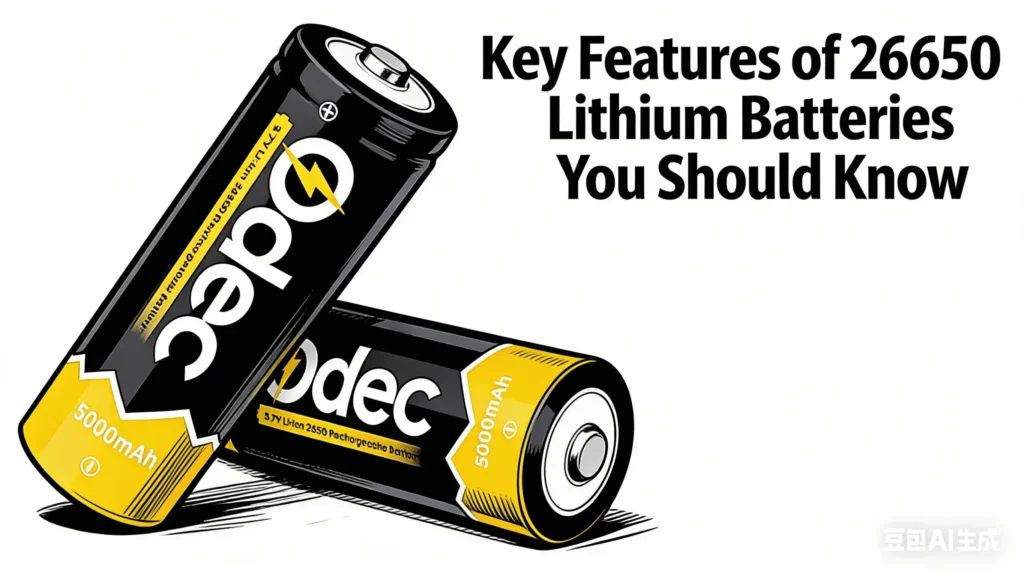
The 26650 lithium battery is a cylindrical rechargeable cell that is often compared with the more common 18650 battery. The name “26650” directly describes its physical size: approximately 26 mm in diameter and 65 mm in length. Because of its larger size, the 26650 battery is designed to deliver higher capacity, stronger current output, and improved safety performance.
In real-world applications, 26650 lithium batteries are widely used in energy storage systems (ESS), electric tools, high-power flashlights, and certain industrial and outdoor devices. This article explains the key features of 26650 lithium batteries, focusing on capacity, discharge capability, cycle life, chemistry options, and typical use cases.
Key Features of 26650 Lithium Batteries
Higher Capacity and Energy Storage
One of the most important advantages of the 26650 battery is its larger single-cell capacity. Most 26650 lithium batteries offer capacities ranging from 3000 mAh to 6000 mAh, depending on the chemistry and design. Some high-quality models reach around 4200 mAh or more.
Compared with 18650 batteries, this higher capacity allows devices to run longer on a single cell. In battery pack design, fewer cells may be needed in parallel, which can simplify system structure and reduce connection losses. This makes 26650 batteries especially suitable for applications that require long runtime and stable power delivery.
Strong High-Discharge Performance
Thanks to their larger internal structure and lower internal resistance, 26650 lithium batteries are well known for high discharge capability. Many models support continuous discharge currents of around 20A, with pulse discharge currents reaching 40A or higher.
This performance makes 26650 batteries ideal for high-power loads such as electric tools, industrial equipment, and high-output LED flashlights. In high-drain scenarios, these batteries maintain voltage stability better than smaller cells, reducing performance drop under heavy load.
Longer Cycle Life
Another key feature of 26650 batteries is their longer cycle life, especially when compared with smaller cylindrical cells. The larger size reduces stress on internal materials during charging and discharging, which helps extend usable lifespan.
Typical cycle life depends on the chemistry:
LiFePO₄ (Lithium Iron Phosphate) 26650 batteries can reach 2000 to 5000 charge cycles
NMC-based 26650 batteries usually offer 800 to 1200 cycles
For applications such as energy storage, backup power, or daily industrial use, a longer cycle life significantly reduces long-term replacement costs.
Chemistry Options for 26650 Batteries
Lithium Iron Phosphate (LiFePO₄)
LiFePO₄ 26650 batteries typically have a nominal voltage of 3.2V. Their main strengths are high safety, thermal stability, and long lifespan. These batteries are highly resistant to thermal runaway and perform reliably in demanding environments.
Because of these characteristics, LiFePO₄ 26650 batteries are commonly used in energy storage systems, UPS solutions, and industrial power applications where safety and durability are critical.
Ternary Lithium (NMC / IMR / INR)
Ternary lithium 26650 batteries usually operate at 3.6V or 3.7V nominal voltage. They offer higher energy density and stronger discharge performance compared with LiFePO₄.
Within this group:
NMC cells prioritize energy density
IMR / INR cells balance high discharge rates with improved safety
These batteries are widely used in power tools, high-output flashlights, and other applications that demand strong current output.
26650 vs. 18650: Key Differences
When choosing between 26650 and 18650 batteries, size and performance differences must be considered. The 26650 battery is significantly thicker and heavier, typically weighing around 94 grams, while an 18650 battery weighs about 45 grams.
From an application perspective:
18650 batteries are better suited for compact, lightweight devices
26650 batteries are better suited for high-power, long-runtime, and safety-focused applications
Because of the size difference, 26650 batteries cannot directly replace 18650 batteries unless the device is specifically designed to support them.
Typical Applications
Due to their performance characteristics, 26650 lithium batteries are commonly used in:
Energy storage systems (ESS) and solar storage solutions
Industrial equipment and electric tools
High-power flashlights and search lights
High-drain consumer products, such as advanced vaping devices
Backup power and safety systems, especially when LiFePO₄ chemistry is used
Their ability to deliver high current safely and consistently makes them a preferred choice in demanding environments.
Maintenance and Safety Considerations
Although 26650 lithium batteries are robust, proper usage is essential. Charging should always be done with a compatible charger designed for the specific battery chemistry. Overcharging or using incorrect chargers can shorten battery life or cause safety issues.
For long-term performance, it is recommended to keep the battery charge level between 20% and 80% during regular use. For storage, batteries should be kept in a cool, dry environment and recharged every 3 to 6 months.
High-quality 26650 batteries typically comply with international standards such as CE, RoHS, and UN38.3, which are important for transportation and commercial use.
Conclusion
The 26650 lithium battery stands out for its high capacity, strong discharge capability, long cycle life, and excellent safety performance. Compared with smaller cylindrical cells, it is better suited for energy-intensive and long-duration applications.
When selecting a 26650 battery, understanding its chemistry options (Li-ion vs. LiFePO₄) and matching them to the intended application is critical. For users who prioritize durability, safety, and high power output, the 26650 lithium battery remains a highly reliable solution.