
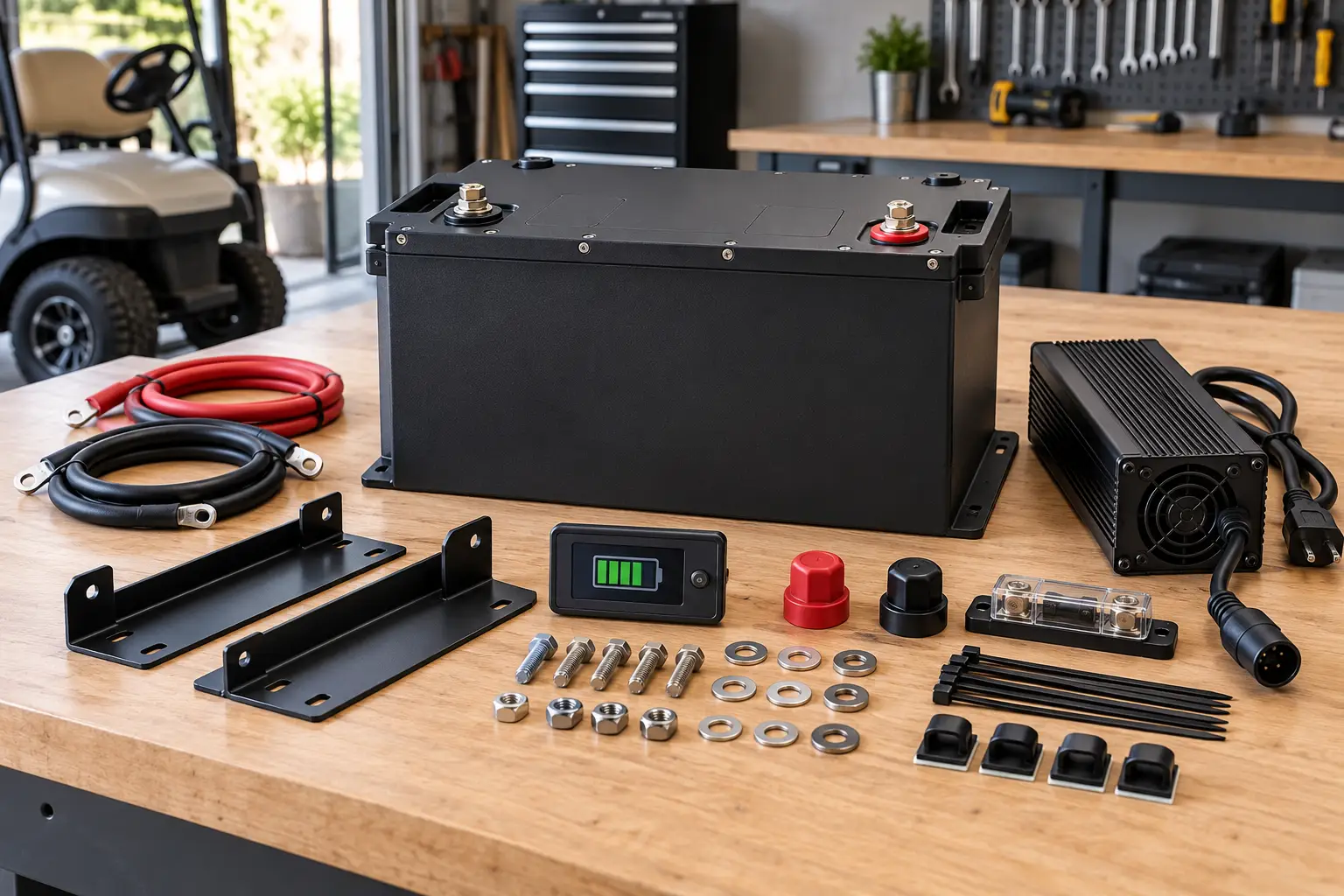
A golf cart lithium battery conversion kit normally includes a LiFePO4 battery pack with a built-in BMS, a lithium-compatible charger, cables and connectors, mounting hardware and a state-of-charge meter. Kits differ, so confirm the parts list, system voltage, tray fit, controller current and charger match before you buy. Cost depends on voltage, capacity, brand, warranty and installation.
Key Takeaways
- A kit is a pack plus a charger, cables, brackets and a meter, and two kits with the same Ah rating can ship with different parts.
- Match the cart’s system voltage, the pack’s series cell count, the charger setpoint and the battery tray size before ordering.
- A charger must suit the pack’s chemistry: Battery University says Li-phosphate batteries and standard Li-ion batteries need different chargers.
- Compare kits by energy in kWh (volts × Ah) and by all-in price, not by Ah or the headline price alone.
- OEM and dealer buyers should ask for the parts list, BMS continuous and peak current, communication options and the scope of any certificates.
What is included in a golf cart lithium conversion kit?
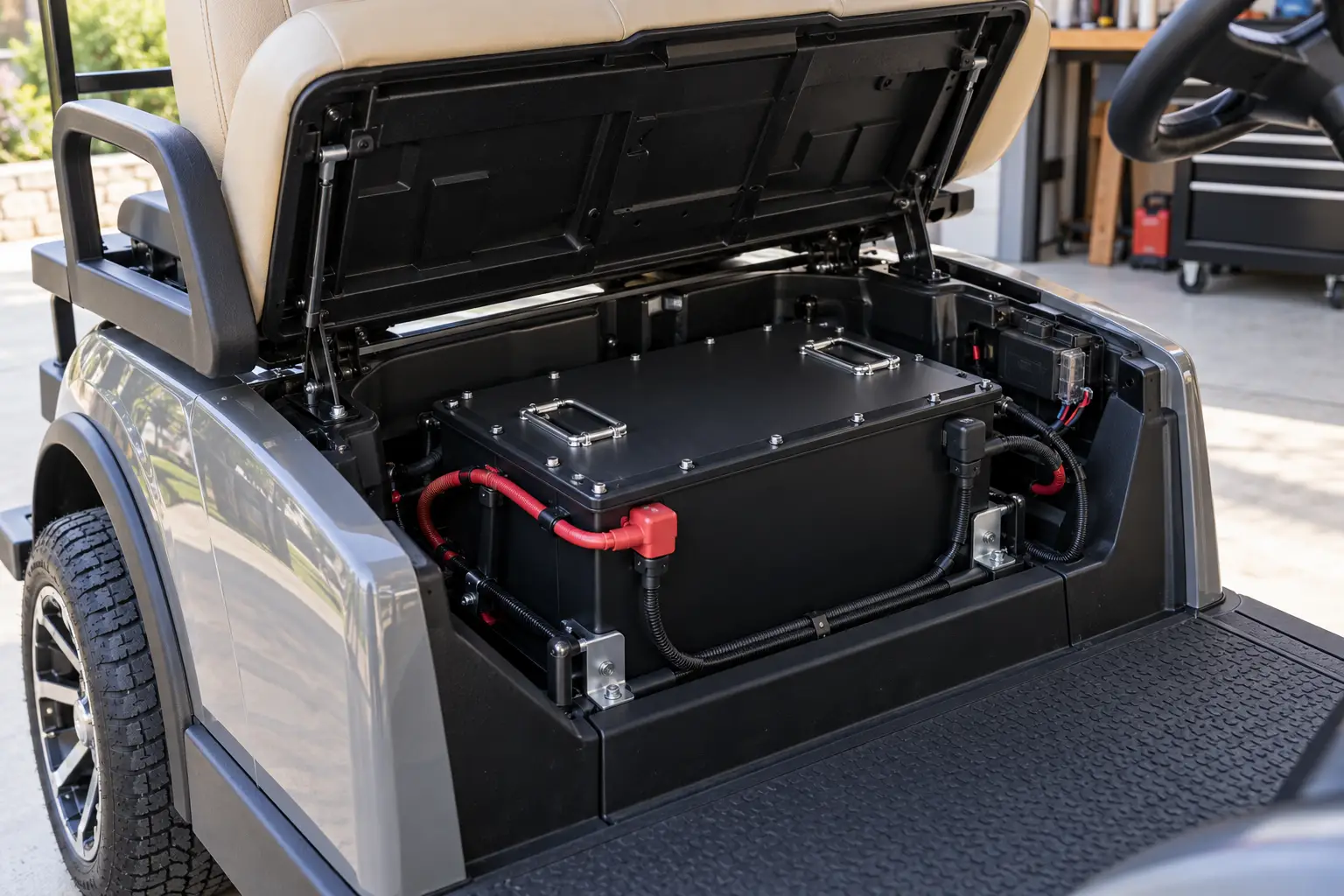
A complete kit replaces the whole lead-acid battery set with one lithium pack and the parts needed to charge, connect and monitor it. The exact contents vary by supplier, so ask for a written parts list.
| Kit item | What it does | What to confirm |
|---|---|---|
| LiFePO4 battery pack | Stores the energy, with cells in series to reach 36 V, 48 V or 72 V | Nominal voltage, series cell count, rated Ah, dimensions, weight |
| Built-in BMS | Protects the cells and limits current | Continuous and peak discharge current, charge current, low-temperature charge limit |
| Lithium charger | Charges to the pack’s voltage limit | Charge voltage setpoint, current rating, connector, on-board or off-board |
| Cables and connectors | Link the pack to the controller and charger | Wire gauge, connector type, fuse or breaker |
| Mounting hardware | Holds a smaller pack in a larger tray | Cart-specific or adjustable brackets |
| Meter or monitor | Shows the charge level | Voltage-only or current-counting, shunt included or not |
Some kits also add a wake-up or power switch and a Bluetooth or display module. Treat these as extras, and check that each one is on the quote.
How do you check that a kit fits your cart?
Check six things before you order: system voltage, series cell count, tray size, controller current, cable gauge and the charger. Work through them in this order:
- System voltage. Add up the old batteries in series. For example, six 8 V batteries make a 48 V system.
- Series cell count. A “48 V” LiFePO4 pack can be 15 cells (37.5–54.75 V) or 16 cells (40.0–58.4 V). The count sets the charger voltage, as shown in Jetray’s LiFePO4 voltage chart.
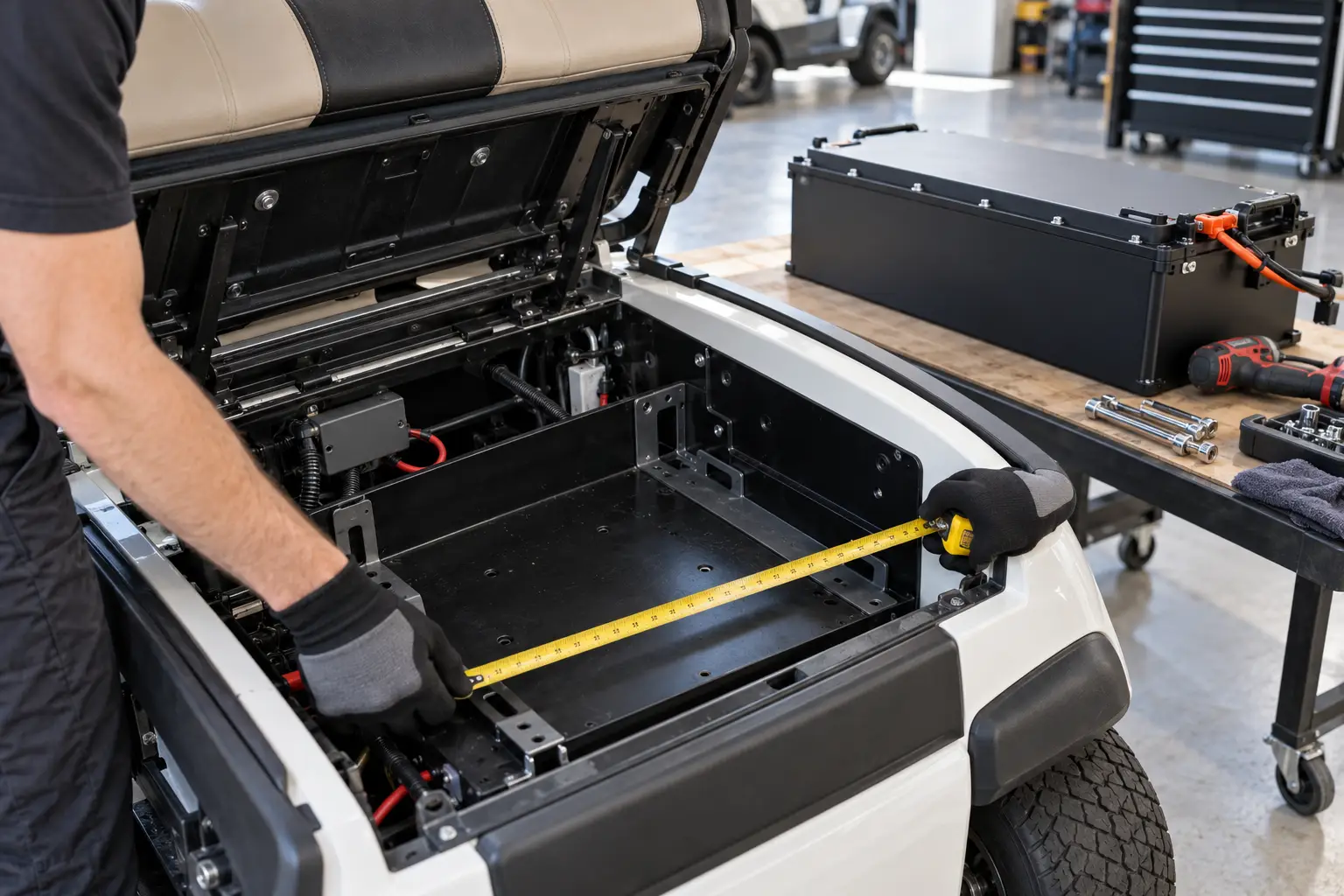
- Tray and mounting. Measure the tray length, width and height, including terminals, and compare them with the pack dimensions. A single pack in a tray built for several batteries usually needs brackets.
- Controller current. The controller decides how much current the cart draws. The BMS continuous and peak discharge ratings must cover that demand.
- Cables and connectors. Check the gauge, connector type and fuse against the pack’s maximum current, and replace worn cables.
- Weight and balance. A lithium pack is a different size and weight from the batteries it replaces, so recheck weight distribution, especially on lifted or towing carts.
Never leave any lead-acid battery in the same string as the lithium pack. The two chemistries use different charging profiles, so one charger cannot suit both.
Why must the charger match the lithium pack?
The charger must be made for the pack’s chemistry and series cell count, and a lead-acid charger is not a substitute. Battery University says chargers for lithium iron phosphate and for standard Li-ion are not interchangeable, and that a Li-phosphate battery in a regular Li-ion charger would be overcharged. It also lists how Li-ion differs from lead acid, with a higher voltage per cell, tighter voltage tolerances and no trickle or float charge at full charge (BU-409).
The EVE Energy LF105 specification gives a LiFePO4 charge limit of 3.65 V per cell, and ends its standard charge when current falls below 0.05C (EVE LF105 specification). Multiply that limit by the series count to get the charger setpoint:
| Cart class | Cells in series | Nominal (× 3.2 V) | Max charge (× 3.65 V) |
|---|---|---|---|
| 36 V | 12S | 38.4 V | 43.8 V |
| 48 V | 15S | 48.0 V | 54.75 V |
| 48 V | 16S | 51.2 V | 58.4 V |
| 72 V | 23S | 73.6 V | 83.95 V |
| 72 V | 24S | 76.8 V | 87.6 V |
Two more charger points matter for golf carts. First, ask whether the charger stops at the end of charge or keeps topping up, because Battery University warns that a continuous trickle charge would plate metallic lithium on Li-ion cells. Its page gives no separate float rule for LFP, so follow the pack maker’s instruction.
Second, avoid charging in the cold. The EVE specification lists a 0°C lower limit for charging, and Battery University says charging lithium-ion below freezing can cause permanent damage. For charger stages in general, see Jetray’s battery charging guide.
What should the BMS match in a golf cart?
The BMS must protect the cells and still allow the current that the cart’s controller asks for. Battery University calls a protection circuit mandatory for Li-ion packs and says each cell in a string needs independent voltage monitoring (BU-304b). It also notes that a protection circuit cannot stop a defect inside a cell.
Ask for these BMS details in writing:
- Continuous discharge current: it should cover the cart’s normal draw on hills and with a full load.
- Peak discharge current: it should cover acceleration, and the rating should state how long the peak lasts.
- Charge current and cut-offs: over-voltage, under-voltage and recovery points, and the low-temperature charge limit.
- Communication: CAN or RS485 if the cart’s controller or display needs pack data.
- Charge meter method: a meter that estimates from voltage alone is rough on LiFePO4, which has a flat curve. A current-counting meter with a shunt is steadier.
What does a lithium conversion cost?
A lithium conversion costs the pack plus every item needed to charge, mount, wire and install it, and the pack is only one line. Published prices vary widely by brand, capacity, region and what the kit includes, so compare your own quotes line by line. Use this table to build the comparison:
| Cost line | What moves it | What to ask |
|---|---|---|
| Battery pack | Voltage, Ah, cell grade, BMS, enclosure | Usable kWh, cell datasheet, rated cycles with test conditions |
| Charger | Current rating, connector, on-board or off-board | Included? Does the setpoint match the series count? |
| Cables, brackets, hardware | Cart model, tray size | Included? What wire gauge? |
| Meter or monitor | Voltage-only or current-counting | Is the shunt included? |
| Controller or wiring changes | Stock controller limits, cable condition | Does the BMS rating fit the controller? |
| Installation | DIY or shop, cart model | Who is responsible if the fit is wrong? |
| Freight and duties | Pack weight, destination, shipping documents | Which terms apply and who clears customs? |
| Warranty | Term, cycle limits, exclusions | What is covered, and who ships a replacement? |
Then convert each quote to the same units. Energy in kWh is nominal voltage × Ah ÷ 1000, so a 48 V, 100 Ah pack holds 4.8 kWh. Divide the all-in kit price by kWh for a cost per kWh. Divide it by rated cycles × usable kWh for a cost per cycle, but only if the cycle rating states the depth of discharge and the end-of-life capacity.
Use the same method for lead-acid. Count every replacement set, watering and maintenance, and charger replacement over the years you plan to keep the cart. Jetray’s lithium-ion vs lead-acid guide covers the chemistry differences.
Should you install the kit yourself?
You can install a kit yourself if you are comfortable with high-current DC wiring, otherwise use a shop that works on electric carts. Both routes need the same preparation:
- DIY: follow the kit maker’s wiring diagram and the cart maker’s service manual, disconnect the old set first and check polarity before connecting.
- Shop install: give the shop the parts list and the BMS current ratings, so it can check the controller and cables.
- After the swap: run a full charge, confirm the charger stops, and test the cart on a hill before relying on the range.
What should OEM and dealer buyers check?
OEM and dealer buyers should treat a conversion kit as a defined product with a parts list, ratings and documents, not as “a 48 V battery”. Ask the supplier for:
- Parts list: every item in the box, with the charger model and the cable gauge.
- Electrical ratings: nominal voltage, series cell count, charge setpoint, and BMS continuous and peak current.
- Cell datasheet: the maker’s limits for voltage, temperature and cycle life, with the test conditions.
- Communication: the protocol and the data available to your controller or dashboard.
- Documents: test reports and certificates for your exact model, with scope and validity dates, plus the transport documents for shipping.
- Commercial terms: MOQ, sample lead time, warranty terms and return handling, all confirmed per project.
Also decide whether you need one fixed kit per cart model or a custom pack. A custom pack costs engineering time but fits the tray and the controller exactly.
How does Jetray approach this?
Jetray’s golf cart battery page groups its LiFePO4 packs by voltage. It describes 36 V packs for light two-seat carts, 48 V packs for four- or six-seat carts, and 72 V packs for higher-speed or special-purpose carts. You can browse the 36V, 48V and 72V LiFePO4 categories.
Two 48V listings that mention golf carts show the details to compare. The figures are as listed on each page, and energy is calculated from nominal voltage × rated capacity:
| Listing | Rated capacity | Energy (calculated) | Listed charge input | Listed max discharge | Listed size |
|---|---|---|---|---|---|
| 48V 80Ah LiFePO4 Lithium Battery | 80 Ah | 3.84 kWh | 58.4 V (10 A / 15 A) | 150 A | 325 × 220 × 350 mm |
| 48V 110Ah LiFePO4 Lithium Battery | 110 Ah | 5.28 kWh | 58.4 V (10 A / 15 A) | 100 A | 385 × 250 × 380 mm |
A 58.4 V charge input equals 16 cells at 3.65 V, though the pages do not state the cell count. The two listings also word their cycle life differently, one as 2000 cycles at 80% DOD and the other as 2000 cycles at 80% capacity, which is why you should ask for the test conditions.
For a cart that no standard pack fits, Jetray’s Customized Service page lists a full custom route: cell selection, BMS design, enclosure and structure design, and communication design, with CAN, RS485, Bluetooth and WiFi options. It asks for the working voltage, current, capacity, peak load and discharge rate, plus the application and working conditions. See the custom battery pack service. For a longer method on voltage and capacity sizing, see Jetray’s golf cart and forklift lithium conversion guide.
Frequently Asked Questions
What is included in a golf cart lithium battery conversion kit?
A golf cart lithium battery conversion kit normally includes a LiFePO4 pack with a BMS, a lithium charger, cables and connectors, mounting brackets and a charge meter. Contents vary by supplier, so get a written parts list. Extras such as a wake-up switch or Bluetooth module should be listed on the quote.
Can you use your old lead-acid charger with a lithium conversion kit?
You should not use a lead-acid charger with a lithium conversion kit unless the pack maker approves it. Battery University says Li-ion has a higher voltage per cell, tighter tolerances and no trickle or float charge at full charge, and that LFP and standard Li-ion chargers are not interchangeable. Use the charger supplied with the kit or one the maker specifies.
Do you need a new controller for a lithium conversion?
You do not always need a new controller for a lithium conversion, but you must check it. The controller sets how much current the cart draws, so compare its rating with the BMS continuous and peak discharge ratings. If the numbers do not match, ask the pack supplier or the cart maker before installing.
Can you mix lithium and lead-acid batteries in one golf cart?
You cannot safely mix lithium and lead-acid batteries in one golf cart string. The two chemistries need different charging profiles, so one charger cannot suit both. Replace the whole set with one lithium pack and its matched charger.
How do you compare golf cart lithium conversion kit prices fairly?
Compare golf cart lithium conversion kit prices by listing every line item and converting each quote to cost per kWh. Include the charger, cables, brackets, meter, installation, freight and warranty. For cost per cycle, use only cycle ratings that state the depth of discharge and end-of-life capacity.
Need a Lithium Pack Built for Your Golf Cart?
Send Jetray your system voltage, tray size, controller current, charger needs and quantity through Contact us, or read about the custom battery pack service. Jetray’s contact page says it replies within 24 hours.
Sources and data checked in October 2026: Battery University BU-409 (Charging Lithium-ion), BU-304b (Making Lithium-ion Safe) and BU-410 (Charging at High and Low Temperatures); EVE Energy LF105 product specification (version F, third-party hosted copy); Jetray golf cart, product and Customized Service pages. Jetray does not state kit prices here, so no price figures are given.