















































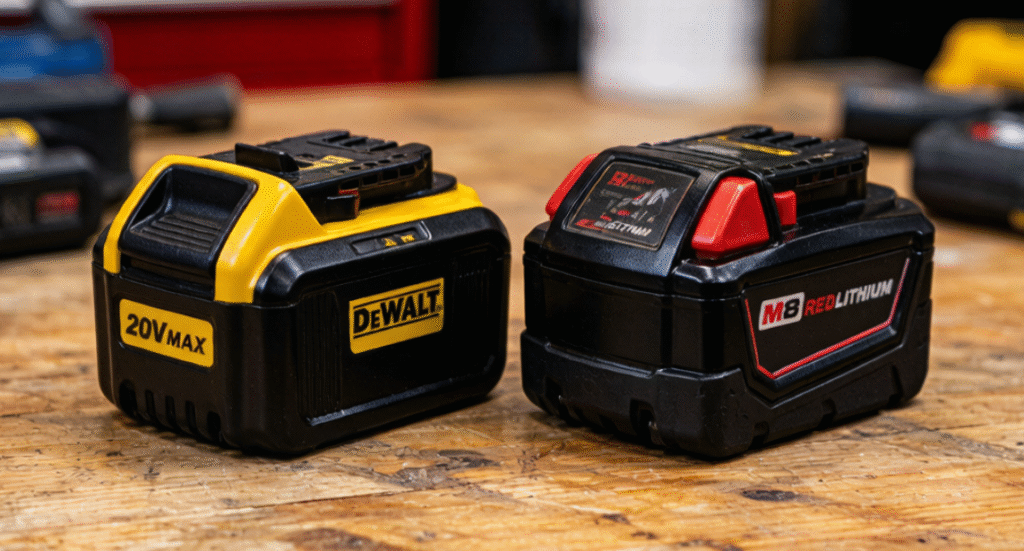
You walk into a hardware store and see DeWalt 20V Max, Milwaukee M18, Makita 18V LXT, Ryobi 18V One+. Is 20V more powerful than 18V? The answer might surprise you.
For battery technology, visit Jetray Battery Packs.
The Great Voltage Confusion
The truth: 18V and 20V Max batteries are electrically identical. Both use 5 lithium-ion cells in series. “20V Max” describes peak voltage (20V); “18V” describes nominal voltage (3.6V x 5 = 18V). Same battery, different label.
A lithium-ion cell has 3.6-3.7V nominal and 4.0-4.2V peak. Five cells = 18V nominal, 20V peak. DeWalt chose peak; Milwaukee and Makita chose nominal.
The Battery Science
| Measurement | Per Cell | 5-Cell Pack |
|---|---|---|
| Nominal voltage | 3.6V | 18V |
| Peak voltage | 4.0-4.2V | 20-21V |
| Cut-off voltage | 3.0-3.3V | 15-16.5V |
Key insight: A DeWalt 20V Max and Milwaukee M18 both operate between 15-21V. They deliver identical power. There is no performance advantage to either labeling system.
See Battery University for cell voltage curve resources.
Brand Naming Comparison
| Brand | Label | Actual Nominal | Cells |
|---|---|---|---|
| DeWalt | 20V Max | 18V | 5 |
| Milwaukee | M18 | 18V | 5 |
| Makita | 18V LXT | 18V | 5 |
| Ryobi | 18V One+ | 18V | 5 |
| Ridgid | 18V | 18V | 5 |
Real-World Performance
Independent testing shows DeWalt 20V Max and Milwaukee M18 drills with similar Ah batteries deliver nearly identical performance. Differences come from motor design (brushless vs brushed), cell quality, and battery capacity — not the voltage label.
What to Buy
Compare: tool ecosystem (which brand offers the tools you need?), battery platform compatibility, Ah rating (higher = longer runtime), cell quality (Samsung/LG vs generic), and price.
Recommendation: Choose the platform, not the number. If you own DeWalt, stay with 20V Max. If you own Milwaukee, stick with M18. The 18V vs 20V debate is irrelevant compared to ecosystem compatibility.
FAQ
Is 20V Max the same as 18V?
Yes. Same cells. 20V peak vs 18V nominal. Electrically identical.
Are they interchangeable?
Not between brands. Brand-specific form factors.
Which is better?
Neither. Choose for tool ecosystem, not voltage label.
Does 20V mean more power?
No. Motor design determines power, not the label.
Are 20V tools more expensive?
Brand positioning determines price, not voltage naming.
Conclusion
The 18V vs 20V Max debate is marketing, not engineering. Both are identical. Choose based on tool ecosystem, battery quality, and value.