
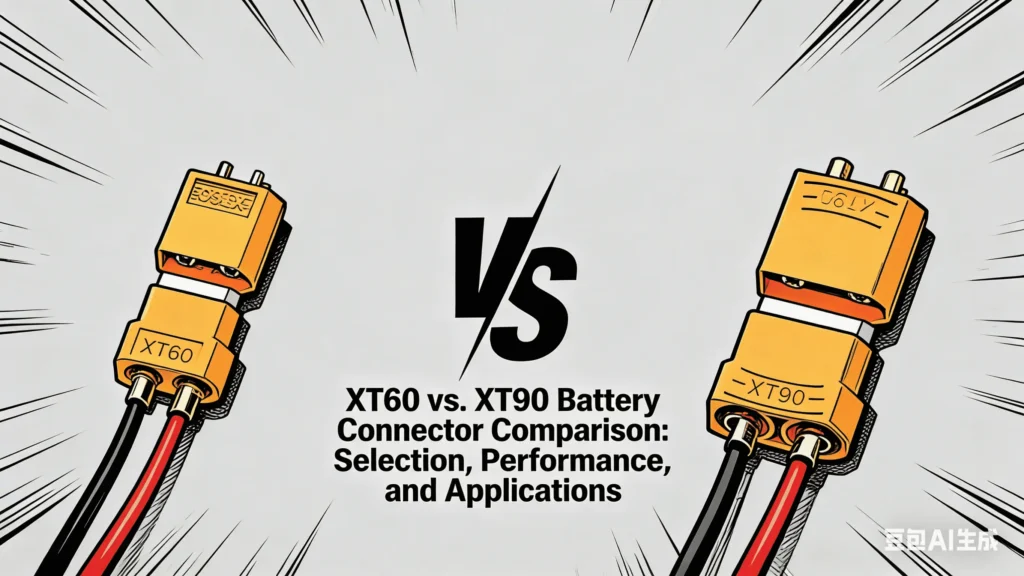
In high-performance RC models, robotics, electric vehicles (EVs), and industrial battery systems, battery connectors play a critical role in overall system safety and reliability. Although small in size, a connector directly affects current delivery, heat generation, and long-term stability.
In real-world applications, many system failures are not caused by batteries or controllers, but by incorrect connector selection. Excessive resistance, overheating, and arcing during connection are common issues when connectors are pushed beyond their limits.
Among the most commonly compared options, XT60 and XT90 are often misunderstood or misused.
This article provides a clear, technical comparison of XT60 and XT90 battery connectors, focusing on specifications, performance differences, safety considerations, and proper use cases.
Introduction
Battery connectors in high-current systems must operate reliably under demanding conditions. Typical applications include:
High-discharge lithium battery packs
RC aircraft, drones, and robotics
Electric scooters, skateboards, and EV subsystems
Industrial equipment and energy storage systems
If a connector is undersized, several problems may occur. These include voltage drop, continuous heat buildup, connector deformation, and in extreme cases, melting or fire. Therefore, choosing the right connector is not about whether it works temporarily, but whether it remains safe and stable over long-term use.
XT60 and XT90 connectors are both widely used, but they are designed for very different electrical loads.
2. Quick Comparison: XT60 vs. XT90
From a design perspective, XT60 connectors are intended for lightweight and medium-power systems, while XT90 connectors are built for higher power and harsher operating conditions. The differences are not only physical but also electrical and thermal.
Key Specification Comparison
| Parameter | XT60 | XT90 |
|---|---|---|
| Continuous Current | 60–75A | 90–120A |
| Peak Current | ~120A | ~180A |
| Recommended Wire Gauge | Up to 10 AWG | Up to 8 AWG |
| Connector Diameter | ~19.5 mm | ~23.5 mm |
| Weight (per pair) | ~15 g | ~28 g |
| Anti-Spark Version | No | XT90S (Yes) |
The table clearly shows that XT90 provides higher current capacity and greater safety margin than XT60.
3. XT60 Deep Dive: Lightweight and Cost-Oriented
XT60 connectors are widely used in FPV drones, RC vehicles, small robots, and electric devices with moderate power demand. These applications often prioritize compact size and low weight over maximum current capacity.
The main advantages of XT60 include:
Compact size, suitable for tight installation spaces
Lightweight design, minimizing impact on total system weight
Low cost and wide availability
Broad compatibility with common cables and accessories
However, XT60 has clear limitations. When continuous current approaches or exceeds 75A, temperature rise becomes significant. Prolonged high-load operation can accelerate connector aging and reduce reliability. In addition, XT60 supports a maximum wire size of 10 AWG, which further limits its suitability for high-power systems.
4. XT90 Deep Dive: High Power and Safety Margin
XT90 connectors are designed for high-current and high-power applications. They are commonly used in electric vehicles, electric skateboards, large UAVs, industrial equipment, and high-capacity battery packs.
Compared with XT60, XT90 offers several important advantages:
Larger contact surface area, reducing contact resistance
Better heat dissipation under continuous high current
Support for thicker wires, up to 8 AWG
Stronger mechanical structure and longer insertion life
An important variant is the XT90S anti-spark connector. This version integrates a pre-charge resistor that limits inrush current during connection. It significantly reduces arcing, which is especially important in high-voltage or large-capacity lithium battery systems. Using XT90S can extend connector life and improve overall system safety.
The main drawbacks of XT90 are its larger size and higher weight. With nearly double the weight of XT60, it is not ideal for weight-sensitive platforms such as small drones.
5. Critical Differences in Real Use
Under real operating conditions, several key performance differences become apparent. At a continuous current of 100A, XT90 typically operates at temperatures more than 20°C lower than XT60. This lower temperature improves connector lifespan and reduces fire risk.
Voltage drop is another major factor. Due to lower contact resistance, XT90 exhibits a smaller voltage drop under load. For example, at 50A, XT90 may show 0.14–0.21V less voltage loss than XT60, improving overall system efficiency by up to 7%.
XT90 also provides greater tolerance for vibration and repeated insertion. Its stronger contact force reduces the risk of intermittent connections in dynamic environments such as electric vehicles or mobile industrial equipment.
6. Selection Guide: Which One Should You Choose?
Choose XT60 if:
Continuous current is below 75A
Weight and space are critical
The system is cost-sensitive
The application is a drone, RC model, or small robot
Choose XT90 if:
Continuous current exceeds 80–100A
The system uses high-capacity lithium batteries
Safety margin and thermal stability are priorities
The application involves EVs, industrial equipment, or high-power tools
If spark suppression is required, especially in high-voltage systems, XT90S should be strongly considered.
8. Conclusion
XT60 and XT90 connectors are designed for different electrical demands. XT60 is a practical choice for lightweight, moderate-power systems, while XT90 is built for high-current, high-reliability applications.
Choosing a connector based only on size or cost can introduce hidden risks. Always match the connector to the actual continuous current, wire gauge, and operating environment. In high-power systems, safety margin should always take priority over convenience.
Selecting the right connector from the start will improve efficiency, reduce maintenance issues, and significantly enhance system safety.