
Introduction
Choosing the right deep cycle battery size is essential for getting the best performance in your RV, boat, solar system, or backup power setup.
This article explains how deep cycle battery sizes are defined, what the standard group sizes mean, how capacity relates to dimensions, and how to choose the best size for your application.
1. What Is a Deep Cycle Battery?
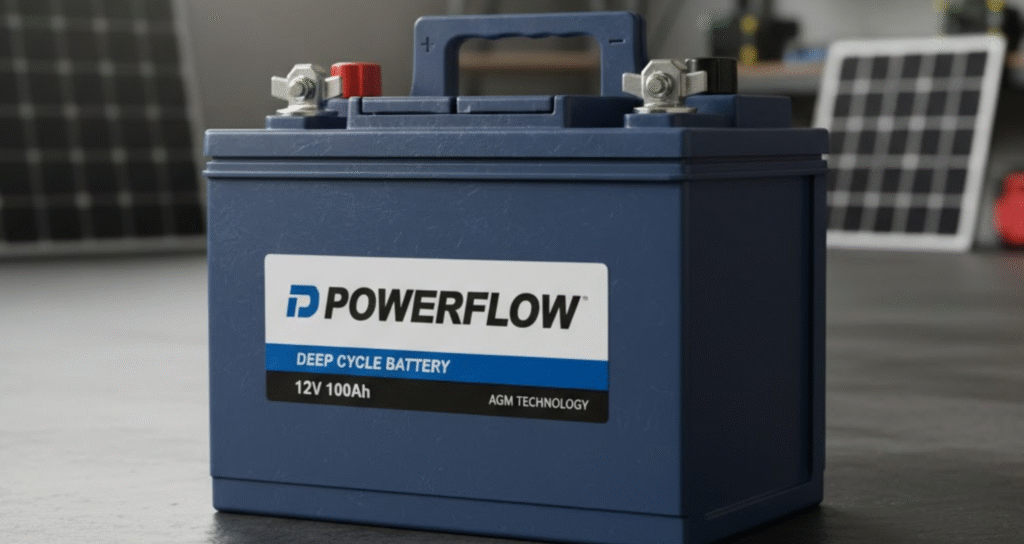
A deep cycle battery is designed to deliver steady power over a long period and can be deeply discharged and recharged many times.
Unlike automotive starting batteries, deep cycle batteries have thicker plates, lower peak currents, and higher cycle life.
Common types include:
Lead-acid batteries: AGM and Gel types
Lithium batteries: LiFePO₄ (Lithium Iron Phosphate)
2V / 6V / 12V modules: Can be connected in series or parallel to form 24V or 48V systems
All these batteries follow standardized physical dimensions (BCI Group Sizes), which make them interchangeable among different brands and devices.
2. BCI Group Size Standards Explained
The Battery Council International (BCI) sets standardized dimensions for batteries, known as “Group Sizes.”
Each group defines the length, width, and height (L×W×H) and typically corresponds to a certain voltage and capacity range.
Larger group numbers usually indicate higher capacity and physical size.
| BCI Group | Voltage (V) | Typical Capacity (Ah) | Dimensions (mm, L×W×H) | Common Applications |
|---|---|---|---|---|
| Group 24 | 12V | 70–85Ah | 260×173×225 | RVs, boats, UPS systems |
| Group 27 | 12V | 90–105Ah | 306×173×225 | Solar storage, small backup |
| Group 31 | 12V | 100–125Ah | 330×173×240 | Industrial, off-grid systems |
| 6V GC2 | 6V | 200–225Ah | 260×180×275 | Golf carts, solar banks |
| 4D | 12V | 180–215Ah | 510×220×250 | Telecom, heavy-duty trucks |
| 8D | 12V | 225–255Ah | 520×270×240 | Marine, large energy systems |
💡 Tip: Bigger batteries store more power but are also heavier and require more installation space.
3. Size Differences Among Battery Types
Lead-Acid Deep Cycle (AGM / Gel)
Uses fixed BCI group sizes.
Affordable and reliable but heavy with lower energy density.
Lithium (LiFePO₄)
Smaller and lighter for the same energy output.
Allows 100% depth of discharge (DOD).
According to RELiON, lithium batteries can deliver the same runtime with about 60% of the capacity of a lead-acid battery.
2V / 6V Modular Batteries
Can be connected in series or parallel for large systems.
Ideal for telecom or solar energy storage where modular flexibility is required.
4. How to Choose the Right Battery Size
Measure the Available Space
Ensure the battery fits into your compartment or battery box.
Leave enough clearance for wiring and ventilation.
Match Power and Capacity Needs
Use this formula:
Ah = (Power W × Hours) ÷ Voltage V
Example:
500 W × 4 hours ÷ 12 V = ≈167 Ah
→ You’ll need at least a Group 31 or 4D battery setup.
Consider Weight and Maintenance
Larger batteries weigh more and can be hard to handle.
For compact installations like RVs or boats, LiFePO₄ batteries are often the best choice.
5. Common Applications and Recommended Sizes
| Application | Recommended Size | Battery Type |
|---|---|---|
| RV & Camper Systems | Group 27 / 31 | AGM or LiFePO₄ |
| Marine / Boat Power | Group 31 / 8D | Sealed Lithium or AGM |
| Solar Energy Storage | 6V GC2 / 4D | Deep Cycle Lead or LiFePO₄ |
| Telecom / UPS Backup | 4D / 8D | High-Capacity AGM |
| Golf Cart / EV | 6V GC2 | High-Rate LiFePO₄ |
6. Summary
Battery size affects both capacity and compatibility.
When choosing a deep cycle battery, always consider your available space, required runtime, and installation limits.
Selecting the correct battery size not only maximizes energy efficiency but also extends system lifespan — whether it’s for your RV, boat, or solar power project.