
If you’ve ever researched energy storage systems, RV power banks, or lithium battery packs, you’ve likely come across the term “3.2V battery.”
But what exactly does it mean? Why not 3.7 V? Is it better or worse?
This article explains everything you need to know — in plain language — about what a 3.2 V battery is, how it works, its main advantages, real-world applications, and what to consider when choosing one for your project.
1. What Is a 3.2V Battery?

A 3.2 V battery typically refers to a Lithium Iron Phosphate (LiFePO₄) cell.
Each single cell has a nominal voltage of 3.2 V, a fully charged voltage of around 3.65 V, and a cut-off discharge voltage around 2.0 V.
Compared with a traditional 3.7 V lithium-ion cell (like NCM or LCO chemistry), LiFePO₄ batteries offer:
Higher safety: excellent thermal stability and lower fire risk.
Longer lifespan: up to 2,000–5,000 cycles.
More stable voltage curve: power output remains steady during discharge.
So while 3.2 V may sound “lower,” it actually represents a safer and more durable battery chemistry.
2. Why 3.2 V Is a Key Voltage
Every battery chemistry has its own “natural” operating voltage — its comfort zone.
For LiFePO₄, that sweet spot is 3.2 V.
What makes 3.2 V so practical is how easily it scales up:
| Configuration | Output Voltage | Common Use |
|---|---|---|
| 4S (4 × 3.2 V) | 12.8 V | Replaces 12 V lead-acid battery |
| 8S (8 × 3.2 V) | 25.6 V | Solar storage systems |
| 16S (16 × 3.2 V) | 51.2 V | EVs, RVs, forklifts, and boats |
That’s why you often see “12.8 V LiFePO₄ batteries” — they’re made by connecting four 3.2 V cells in series.
This modular flexibility makes 3.2 V cells extremely popular for renewable energy and electric vehicle applications.
3. Core Materials and Chemistry
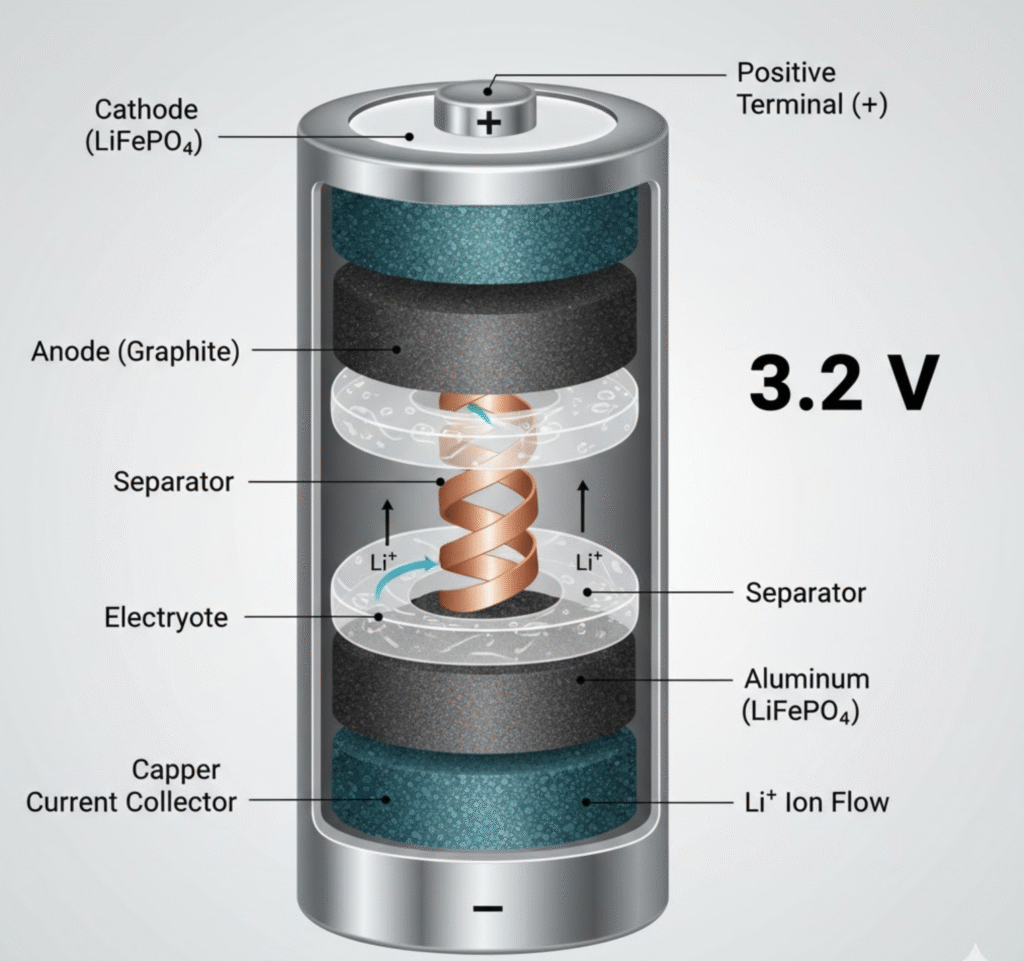
A 3.2 V LiFePO₄ battery typically consists of:
Cathode: Lithium Iron Phosphate (LiFePO₄) — gives the battery its stability and long life.
Anode: Graphite — provides efficient lithium-ion movement during charge/discharge.
Electrolyte: Organic solvents and lithium salts — ensure ionic conductivity.
Separator: Prevents short circuits and maintains safety.
This combination makes the 3.2 V battery exceptionally safe, durable, and recyclable.
It may not reach the same energy density as high-voltage NCM batteries, but for long-term and heavy-duty use, it’s a far better investment.
4. Charge and Discharge Characteristics
The 3.2 V battery is known for its smooth and forgiving charge/discharge behavior — ideal for continuous cycling.
Charging: Usually follows a Constant-Current (CC) + Constant-Voltage (CV) pattern. The charging current gradually decreases as voltage reaches 3.65 V.
Discharging: The voltage remains almost flat around 3.2–3.3 V before dropping near the end of the cycle.
Protection: Avoid over-discharging below 2.0 V; doing so can shorten lifespan or cause damage.
In short, it’s a steady performer — no sudden voltage drops or overheating issues, which makes system integration much simpler.
5. 3.2V vs. 3.7V Batteries
| Feature | 3.2 V LiFePO₄ Battery | 3.7 V Li-ion Battery |
|---|---|---|
| Chemistry | LiFePO₄ | NCM / LCO / NCA |
| Nominal Voltage | 3.2 V | 3.7 V |
| Charge Voltage | 3.65 V | 4.2 V |
| Cycle Life | 2,000–5,000 cycles | 500–1,000 cycles |
| Energy Density | Moderate | Higher |
| Safety | Excellent | Lower |
| Temperature Tolerance | Wide | Moderate |
| Typical Use | Storage, RVs, EVs | Phones, laptops, drones |
While 3.7 V lithium-ion cells offer higher energy density, 3.2 V LiFePO₄ batteries win in safety, longevity, and thermal stability.
They’re ideal for heavy-duty or high-cycle applications where reliability matters more than compact size.
6. Common Applications
Solar Energy Storage
3.2 V LiFePO₄ batteries are a top choice for solar systems thanks to their high safety and long lifespan. They can handle daily charge-discharge cycles for years with minimal capacity loss.
RVs and Off-Grid Living
For travelers, stability equals comfort. These batteries deliver consistent power for lights, appliances, and inverters without voltage fluctuation.
UPS and Backup Systems
They outperform lead-acid batteries in hot or harsh environments, offering faster charging, longer service life, and lower maintenance costs.
Industrial & Electric Equipment
Forklifts, e-bikes, tools, and marine devices benefit from their strong discharge current and robust reliability.
7. Advantages and Limitations
Advantages
Outstanding safety and thermal stability.
Long cycle life — thousands of charge/discharge cycles.
Stable voltage platform for sensitive electronics.
Fast charging and high discharge rates.
Environmentally friendly and recyclable materials.
Limitations
Slightly lower energy density than NCM batteries.
Higher upfront cost, though offset by longer lifespan.
Reduced low-temperature performance below −10 °C.
However, for most B2B and industrial users, these trade-offs are more than acceptable — reliability always beats maximum capacity on paper.
8. Buying Guide: How to Choose the Right 3.2V Battery
Here are practical tips when sourcing or customizing 3.2 V LiFePO₄ cells:
Define your system voltage: single cell (3.2 V) or module (12.8 V, 25.6 V, etc.).
Check rated cycle life: reliable cells should specify ≥2,000 cycles at 80% capacity.
Verify certifications: look for UL, CE, UN38.3, MSDS, and IEC compliance.
Match your charger and BMS: ensure charging voltage and cutoff protection fit the 3.2 V platform.
Assess the manufacturer’s capability: prefer those with in-house cell production and quality control, not just re-labeling.
9. Who Should Use 3.2V Batteries?
You should consider 3.2 V LiFePO₄ batteries if you:
Need safe, long-life power for your system.
Operate frequent charge/discharge cycles (e.g., solar, EV, UPS).
Want to replace lead-acid batteries with a lighter, greener alternative.
Build or distribute RVs, boats, solar systems, or industrial machines.
These batteries are built for professionals who prioritize reliability, safety, and performance consistency.
10. Final Thoughts
The 3.2 V battery isn’t about chasing higher voltage — it’s about balance.
It represents a smarter, safer, and more sustainable way to store energy.
As renewable energy and electric mobility grow, LiFePO₄ batteries are quickly becoming the backbone of long-term power solutions.
Whether you’re a manufacturer, system integrator, or project developer, understanding the logic behind the 3.2 V platform will help you build safer, longer-lasting, and more cost-effective energy systems.